
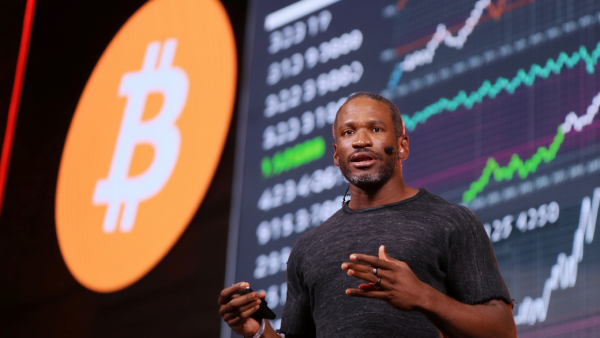
[DigitalToday reporter Jinju Hong] Arthur Hayes (아서 헤이즈), co-founder of BitMEX, argued that moves by major AI companies to slow their development pace are linked to profitability concerns rather than safety. He said if AI-related debt shocks financial markets, it could instead create a liquidity environment favourable to bitcoin.
CoinPost, a blockchain outlet, reported on Sept. 22 that Hayes laid out the view in his newsletter, "Crypto Trader Digest", citing signs that Anthropic, OpenAI and SpaceX are adjusting the pace of artificial general intelligence (AGI) development.
Hayes said those companies cite "safety" as the reason for slowing AI development, but the moves may instead reflect the huge costs required for AI development and deteriorating profitability.
He said computing demand from U.S. AI companies supports more than $1 trillion in investment-grade debt alone. He added that if lower-rated corporate bonds and loans are included, financial assets worth hundreds of billions of dollars are tied to AI investment.
Hayes said a slowdown in AI development would not simply delay technical timelines, but could also affect the value of AI data centres and related financial assets.
He said U.S. AI companies are facing profitability pressure as they compete on price with low-cost Chinese AI models. With demand rising not only for high-performance AI but also for AI that can be used at low cost, he said U.S. models would struggle to keep up with Chinese models on price.
Hayes said in this environment, AI companies may shift strategy toward using existing computing resources more efficiently rather than spending huge sums to develop new large models. He argued that if computing demand for training new models falls short of expectations, it could affect investment and financing for AI data centres.
The problem, he said, is that a large share of AI infrastructure investment has been financed through debt. Hayes argued that if credit demand for AI data centres and related companies slows, the value of related debt could fall, and insurers could become a weak link in the process.
Citing analysis by "Mispriced Assets", Hayes said a structure is spreading in which private equity firms acquire insurers, set up affiliated reinsurers and use them to secure the regulatory capital buffers required. He also noted that some affiliated reinsurers are registered in relatively lightly regulated locations such as the U.S. state of Vermont.
He said assets held by affiliated reinsurers could include up to $1.54 trillion linked to AI data centre debt or private credit targeting AI companies. He also cited as a problem that it is difficult for outsiders to assess the true soundness of those assets.
As an example, he cited a case involving asset valuation at a Brookfield-affiliated reinsurer. He said the reinsurer's assets were valued at $1.48 billion but were reported to regulators as carrying no payment obligation.
Hayes said if computing demand from AI companies slows faster than expected, credit rating agencies could also cut ratings on debt tied to AI data centres. He said insurers holding those assets could then face a situation where they need to secure additional capital.
He also mentioned the possibility of U.S. government intervention. Hayes said the government could act as the "buyer of last resort" for AI computing resources on national security grounds, or consider options to support the insurance industry as in the AIG case during the 2008 financial crisis.
Hayes said he is focused on potential liquidity expansion that could arise in such crisis responses. If the government supplies funds to stabilise financial markets or increases the money supply, financial conditions could ease, and some funds could flow into the cryptocurrency market including bitcoin, he argued.
He said that even if an AI investment slowdown shocks financial markets, bitcoin could face a more favourable environment if responses by the government and financial authorities ultimately expand liquidity.
He said this is a scenario based on his personal outlook. How far an AI investment slowdown will actually go, whether creditworthiness of AI data centre-related debt will deteriorate, whether insurers' capital burdens will materialise, and how the U.S. government would respond have not yet been confirmed.
Hayes' argument focuses not on the slowdown in AI industry growth itself but on potential financial-market shocks during the process and the policy response. If AI computing demand, related debt and insurers' capital burdens change in practice, how that affects financial-market liquidity and the bitcoin market will remain a point to watch.
 Jinju Hong
hongjj@d-today.co.kr
Jinju Hong
hongjj@d-today.co.kr