
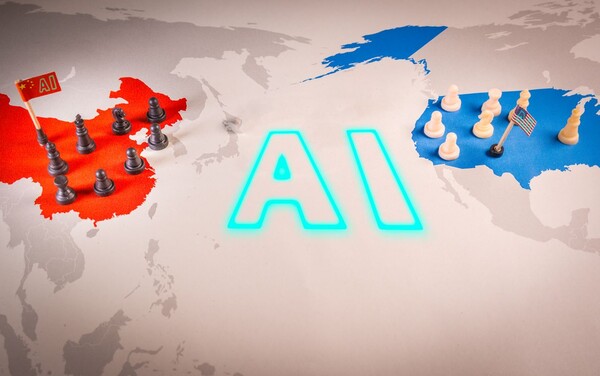
[DigitalToday AI Reporter] An analysis says both the United States and China will struggle to secure an edge in the race for leadership in artificial intelligence (AI) without relying on other countries’ technology and supply chains.
On Sept. 21 (local time), the Hong Kong South China Morning Post reported that Matty Zhao (매티 자오), co-head of China equities at Bank of America Global Research, said the global tech supply chain is deeply intertwined and no single country can complete the AI race on its own.
Zhao pointed to China’s strengths in power grids and manufacturing equipment, but said it still depends on overseas suppliers for advanced chips, memory and some high-end materials. He said the United States faces different constraints. The average age of the U.S. power grid is 30 to 40 years, making it more outdated than China’s 15 to 20 years, he said.
In the United States, political and local opposition is also continuing as concerns grow over rising electricity bills due to data centre expansion. Zhao said power could be a limiting factor for U.S. AI growth. He said China also still needs a breakthrough in advanced chips.
He also stressed that cooperation with other countries is unavoidable for both the United States and China. Zhao cited South Korea’s competitiveness in memory semiconductors and Japan’s strengths in high-end materials and manufacturing equipment, saying the AI supply chain is formed across multiple countries. He also said competition and cooperation will continue together.
The remarks came ahead of a Washington meeting on Sept. 24 between Chinese President Xi Jinping (시진핑) and U.S. President Donald Trump. AI is expected to be a major agenda item at the talks, along with trade and geopolitical issues. Earlier, U.S. Treasury Secretary Scott Bessent (스콧 베선트) and Chinese Vice Premier He Lifeng (허리펑) held talks in New York on Sept. 20 for about 8 hours and agreed to create an AI dialogue channel and launch a bilateral trade body.
Technological distrust between the two countries remains. The United States has repeatedly raised concerns that Chinese developers are using distillation methods to leverage capabilities of leading U.S. AI models. China has criticised calls in the United States to slow the pace of frontier AI development, saying it could entrench U.S. technological advantage.
The two countries are also moving in parallel to reduce mutual dependence in core technologies. Anthropic CEO Dario Amodei (다리오 아모데이) urged the U.S. government to tighten controls on chip exports to China, and China is pushing domestic technology companies to expand adoption of locally made semiconductors.
Even so, AI infrastructure remains globally divided by specialised roles. China has emerged as a major supplier of power equipment and energy storage systems, and transformer exports have also surged. China’s 2025 transformer exports reached 64.6 billion yuan (about 13.15 trillion won), up about 36 percent from a year earlier and marking a record high. Still, China continues to depend on Japan for specialised equipment and materials, and on the United States and others for advanced chips and some optical technologies.
 Seung-a Yoo
ysah@d-today.co.kr
Seung-a Yoo
ysah@d-today.co.kr