
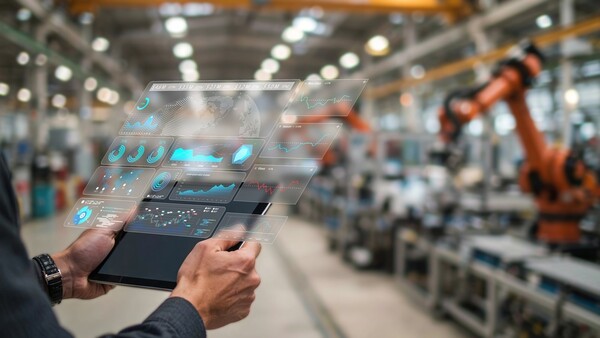
·[DigitalToday reporter Jin-ho Lee (이진호)] South Korea’s three mobile carriers, which are pursuing a shift into AI companies, are expanding into robots and manufacturing sites. They are accelerating development and commercialisation of “physical AI”, which recognises real-world space and takes actions directly, as a new growth area.
Physical AI goes beyond existing AI that generates text or images. It recognises and judges the surrounding environment, then carries out real actions through robots or devices. Key technologies include VLA (Vision-Language-Action), which links visual information and natural language to actions, digital twins that recreate real space virtually, and robot training data.
The telecom industry is focusing on physical AI because it can fully leverage existing infrastructure such as networks, cloud services and data centres. The three carriers judge they have a favourable environment for physical AI, such as exchanging large-scale data in real time over stable networks and quickly processing on-site data through edge infrastructure.
SKT targets manufacturing sites with digital twins.
SK Telecom is expanding digital twin technology it secured in manufacturing AI into physical AI. It recreates real factories and equipment in virtual space, checks outcomes in advance when processes or equipment layouts change, and uses it for robot training.
Earlier, SKT applied Nvidia Omniverse-based digital twin technology to an SK Hynix semiconductor fab. The core is to recreate the manufacturing site in virtual space so it can verify in advance the impact of production line changes or equipment layout adjustments. It is also working to secure and standardise robot training data. As robots need massive data to repeatedly experience diverse situations in real sites, it plans to build a system that generates data and trains robots in virtual space.
SKT has also moved to global technology standardisation. Its proposal to the International Telecommunication Union Telecommunication Standardization Sector (ITU-T) for a “robot data factory interworking structure and method” was adopted as a new standardisation item. The technology is intended to efficiently use robot training data by linking different data formats used by different manufacturers or platforms.
It also expanded cooperation with startups. In July, it held a meeting with eight domestic robotics startups and discussed building training data to develop robot foundation models (RFM) in digital twin spaces and plans for joint demonstrations at manufacturing, logistics and service sites. SKT said, “We expect this cooperation discussion will help bring forward field application and commercialisation of technologies in the research stage,” and added it would “expand partnerships with domestic physical AI startups to lead the development of the robotics ecosystem.”
KT ties different robots into one, drawing attention to ‘K RaaS’.
KT is focusing on “orchestration” that connects multiple robots and facilities rather than on robots themselves. The key is its robot service platform, K RaaS (KT Robot as a Service). K RaaS supports manufacturers in managing different robots, existing industrial facilities and corporate IT systems. For example, in a logistics centre it can connect mobile robots as well as a warehouse management system (WMS), elevators and automatic doors to integrate the overall workflow.
KT is also developing VLA-based technology that enables robots to understand surrounding situations and human instructions and act accordingly. The goal is to apply it to various forms such as humanoids and mobile robots without being tied to a specific manufacturer. In February, KT unveiled at MWC26 in Barcelona a scenario in which a humanoid checks the condition of parts and then instructs a mobile robot to carry out transport tasks. KT aims to create an intelligent physical AI ecosystem through such an organic work system.
KT is currently expanding the scope of K RaaS applications at semiconductor manufacturing plants, logistics centres and smart buildings. A KT official said it would expand its physical AI technology beyond manufacturing and logistics to hotels, retail and healthcare.
Demonstrations targeting industrial sites are also under way. KT is participating in the Ministry of Science and ICT’s “high-performance AI network foundation-building project” and is building AI-RAN-based physical AI services with Samsung Electronics and HD Hyundai Samho at HD Hyundai Samho’s shipyard in Yeongam, South Jeolla Province. It is conducting demonstrations of process automation, including precision welding by a quadruped welding robot and an autonomous driving painting robot at shipyard welding and painting plants, to verify productivity and safety.
LG Uplus targets “everyday physical AI” with IxiO.
LG Uplus is focusing on linking the carrier’s strength in voice to physical AI. In this approach, IxiO understands a user’s situation based on call content and determines necessary actions, and a humanoid then carries out those actions.
For example, if a user mentions a business trip during a call, IxiO checks schedules and weather and a humanoid packs needed items. The company aims to expand it into “ambient AI” that links smart glasses, wearables, home appliances and vehicles to provide situation-appropriate services without users giving separate commands.
It is also pursuing network technology development to support physical AI. LG Uplus verified a technology that maintains connections even when robots or drones move between different networks by linking a 5G network and an AI-RAN test network with Yonsei University. It judged that uninterrupted communications are needed for physical AI to operate across various spaces beyond factories and logistics centres.
The industry, however, sees significant challenges before the three carriers’ physical AI investments translate into actual revenue. It is because specific effects such as cost reduction or productivity gains have not yet been fully proven.
An industry official said, “All three companies are at a stage of verifying how efficiently the technology can be used at real industrial sites rather than focusing on immediate profitability,” adding, “Commercialisation is highly likely to occur first in business-to-business (B2B) areas such as manufacturing and logistics, where the effects relative to investment can be confirmed relatively clearly.”
 Jin-ho Lee
jhlee26@d-today.co.kr
Jin-ho Lee
jhlee26@d-today.co.kr