
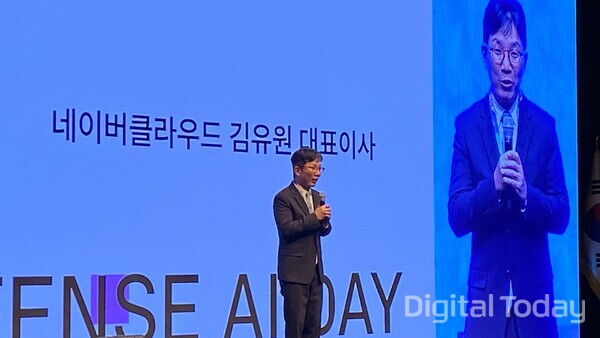
Naver Cloud is moving to target the defence AI transformation (AX) market, highlighting "sovereign AI" in which the military directly holds control over data and AI models, and full-stack capabilities spanning everything from infrastructure to models, data platforms and applications. It plans to have field deployment engineers enter the military's closed network and continuously upgrade the technology to fit real military data and mission environments.
Naver Cloud CEO Yoo Won-kim (김유원) said at the "Defense AI Strategy Seminar (Defense AI Day)" held at the Shilla Hotel in Seoul on Sept. 18, "Defence AI should not end with adopting technology. It must continue through defining the problems the military needs, validating them in the field and turning them into capabilities." He added, "We will become a key partner linking the capabilities of the military, defence companies, startups and research institutes."
Naver Cloud's proposed defence AX full stack consists of five layers: infrastructure, AI models, data fabric, applications and field deployment engineers. It ties the entire process into a single system, from model development to data connectivity, real mission application and field improvement.
Naver Cloud Executive Vice President Yoo Kyung-beom (유경범), who heads its defence business, said, "Sovereignty in defence is not a choice but a condition for survival," stressing that the military must directly take control over data, AI models and platforms.
Naver Cloud plans to first prepare AI models and development tools using open and non-classified data, then bring them into the closed network with field deployment engineers to upgrade them using real military data. It aims for a long-term collaboration model in which the military and private sector improve performance together in the field, rather than a one-off build.
◆ Intelligent autonomous weapon systems with world models
Naver Cloud Executive Vice President Sung Nak-ho (성낙호), head of AI technology, presented spatial intelligence and world models as key technologies for intelligent autonomous weapon systems. He said it would build an "intelligent network" that understands information collected by drones and various sensors as a single battlefield situation, with multiple AIs linked and operating together.
Naver Cloud is developing technology that reconstructs real space in 3D based on drone footage and combines information from multiple sensors. It is also conducting internal demonstrations of technology that directly controls drones with AI.
World models are used to simulate how specific actions will lead to outcomes by reflecting battlefield variables such as terrain, weather and radar.
Sung said, "A world model is meant to simulate what outcome will result from a given action," adding, "If you can predict, you can also evolve."
◆ Linking battlefield information with data fabric and ontology
In data, it links and structures battlefield information scattered across services and systems using data fabric and ontology.
Naver Cloud Director Lee So-eun (이소은) said, "The key to successful defence AI lies in connecting and structuring defence data, the stage before applying AI technology."
Data fabric connects data from different systems such as drones, satellites, radar and surveillance assets without changing existing systems. It applies a virtualisation method that accesses needed information while leaving it in its original location rather than moving it to a separate repository, allowing existing network separation and security policies to be maintained.
It combines this with a "Korean-style standard ontology" that pre-structures relationships among units, forces, assets and manuals. When a target is identified, it analyses surrounding forces along with terrain and weather, past actions and relevant doctrine to determine the operational meaning of the current situation.
Based on this, it supports commanders' decisions by presenting multiple response options and risk factors, rules of engagement (ROE) and the basis for judgments. The final judgment and orders are made by the commander.
Naver Cloud plans to provide data fabric and ontology as the core of a defence AI platform and to connect external companies' AI solutions such as video analysis, speech recognition and specialised inference.
◆ Connecting command centres and the battlefield with a closed-network cloud
In infrastructure, it will build a defence-specialised cloud connecting central operations, operational hubs and forward field sites so AI can be run even in military environments separated from outside networks.
Naver Cloud Director Park Jong-geon (박종건) classified the defence-specialised cloud into a centralised integrated type, a mission-hub type and a field-operation type. In the centre, large-scale GPUs train and evaluate models, while each service, operational hub and forward area runs the AI it needs.
It will enable missions to continue with approved AI and local data even when communications are cut, and reconnect data and logs accumulated in the field to the centre once connectivity is restored. Improved models are redistributed after the military's verification and approval procedures.
Park said, "The key question is not who operates it but who holds final decision-making authority," adding, "Even if operations are shared, final control over missions and data policy must be with the military."
 Seulgi Son
sageson@d-today.co.kr
Seulgi Son
sageson@d-today.co.kr