
South Korea's Ministry of Science and ICT is speeding up its response as forecasts emerge that the golden time in physical AI competition could end within the next 3 years. It plans to begin developing robot foundation models (RFM) and world models from next year and to run technology development in parallel with on-site demonstrations to respond to global competition.
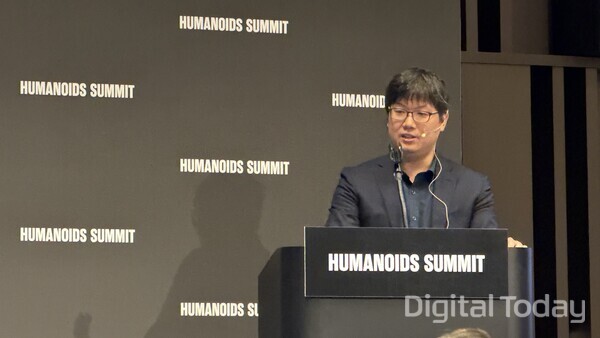
Song Chang-jong (송창종), head of the Device AX Innovation Team at the science ministry, said at the Humanoid Summit Seoul 2026 held at COEX in Seoul on Sept. 22 that physical AI is a field where there is still no right answer on model architecture or how to secure data, and trial and error is inevitable. He said that as forecasts suggest the golden time could close within 3 years, the ministry will push model development, data accumulation and on-site application together from next year so it does not miss the moment.
The government will support development of RFMs and world models by pursuing a large-scale research and development project from next year. It plans to create a structure in which not only AI models but also data, robots and demand-side companies at worksites participate together, and to test diverse methodologies rather than concentrate on a specific technical approach.
It will also work in parallel to secure data needed to train physical AI. It will build a physical data library next year and establish a system to produce and evaluate high-quality data. As the quality of data matters as well as quantity, it plans to find suitable approaches through trial and error on which sensors to use and what data to collect and evaluate.
The government will also move to apply the technology in the field at the same time as development. Song said the existing approach of applying technology after completing it has several limitations in keeping up with global speed, and the ministry wants to support field application alongside support for technology development.
From next year it plans to apply physical AI early in areas with high potential for adoption, including mail and logistics. The goal is to create a virtuous cycle in which AI models are applied at worksites and data generated there are used again to advance the models.
Manufacturing and logistics are cited as early application areas because the effect relative to investment is relatively clear, environments can be controlled comparatively, and labour shortages are growing due to a decline in the working-age population. Over the medium to long term, the government is also reviewing ways to expand use to care and support for the daily lives of people with disabilities.
Even so, technical uncertainty and a lack of data remain issues to be solved. Song described physical AI as an undefined field, saying that unlike large language models it is unclear what the model structure and model size should be and which approach is best.
Generative AI can use vast amounts of data accumulated on the internet for training, but real-world physical data that can be used for physical AI are insufficient in absolute volume. There is also no common methodology yet on which sensors should be used to collect what data.
The government plans to support attempts at diverse models and data-building approaches rather than preselecting a single right answer. Song said trial and error is inevitable, and it is necessary to try as many approaches as possible and improve by learning in the process.
The size of government investment has not yet been finalised. Song said budgets have not been fully confirmed yet.
The government will also expand cooperation among industry, universities and research institutes, and related ministries. The science ministry has launched a Physical AI Alliance this year to support cooperation among companies related to AI models, data and robots.
It is also working with the Ministry of Trade, Industry and Energy, the Office of Government Policy Coordination and the Ministry of SMEs and Startups. Physical AI requires expertise not only in AI technology but also in robots, manufacturing sites and industry-specific data, he said, making close inter-ministerial cooperation necessary.
Song said there is recognition that physical AI is a path that must be taken, and that the government is treating it as a key pillar of important projects. He said it will work to respond in time and raise physical AI into a core industry.
Humanoid Summit Seoul 2026 is hosted by ALM Ventures, a Silicon Valley venture capital firm, and local physical AI company RealWorld is participating as a technology partner. Speakers include representatives from overseas companies such as Nvidia, Qualcomm, Unitree and Robotera, as well as local companies including RealWorld and Robotis.
 Seulgi Son
sageson@d-today.co.kr
Seulgi Son
sageson@d-today.co.kr