
[DigitalToday reporter Jin-ho Lee] The government has drawn up ethical standards researchers must follow when using AI in the national research and development (R&D) process. It limits AI to a research tool and assigns responsibility and rights for final outputs to researchers.
The Ministry of Science and ICT said on Saturday it finalised the National R&D AI Research Ethics Guide after review and approval by the National Science and Technology Advisory Council’s steering committee.
As AI is used across the entire research process, productivity has risen, but new research ethics issues have emerged. These include generating inaccurate information, replicating bias, leaks of security and personal data, and unclear citations. The guide includes a basic principle that AI’s role in national R&D is limited to a tool and that responsibility and rights for final outputs rest with the researcher who uses AI.
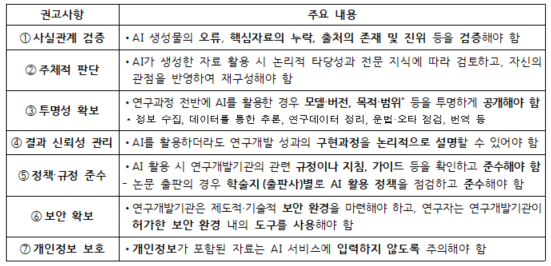
The ministry presented seven recommendations for researchers to follow: verifying facts, independent judgement, ensuring transparency, managing reliability of results, complying with policies and rules, ensuring security and protecting personal information.
Researchers must directly verify errors in AI-generated material, whether key data are missing, and the existence and reliability of sources. When using AI-generated data, they must review it based on expertise and logical validity and restructure it to reflect their own perspective. When AI is used in research, researchers are required to disclose the model and version used, as well as the purpose and scope of use. Research results that use AI must also be able to logically explain the implementation process.
Research institutions must create a secure environment for using AI, and researchers must use environments and tools approved by their institutions. The guide also advises caution not to enter materials containing personal information into external AI services.
Standards were also set for evaluating national R&D projects and reviewing papers. Evaluators must assess materials themselves without entering evaluation materials into external AI services. Those being evaluated must not use hidden prompts to evade review criteria or distort evaluation results.
The ministry plans to distribute the guide and an explanatory booklet to research institutions and continuously improve them by collecting feedback from the field. It will also provide a researcher self-checklist to assess the level of AI use and a disclosure form on whether AI was used for submitting R&D project reports.
Hong Soon-jung (홍순정), director general of the Performance Evaluation Policy Bureau at the ministry, said, "I hope this guide will serve as an opportunity to establish a culture of responsible AI use in the research field and ensure the integrity of national R&D research."
 Jin-ho Lee
jhlee26@d-today.co.kr
Jin-ho Lee
jhlee26@d-today.co.kr