
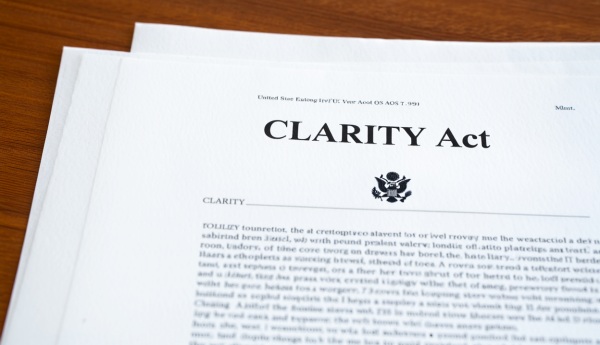
The U.S. Senate is moving to take up the Clarity Act, a cryptocurrency market-structure bill, but a failure to pass it this year could increase the likelihood it is redesigned in full in the new Congress in 2027 or effectively scrapped, an outlook shows.
On Sept. 9, local time, Cointelegraph reported the Senate will resume its session on Sept. 14 after a five-week recess. John Thune (John Thune), the Republican Senate majority leader, plans to hold a cloture vote on the Clarity Act on Sept. 15. Advancing the bill requires 60 votes, leaving Republicans needing support from some Democrats.
If the bill fails to secure 60 votes, three-fifths of the chamber, the remaining legislative calendar this year becomes even tighter. The Senate is expected to have fewer than 36 days left in session in which it can take up legislation before the new Congress begins in 2027.
Another variable is that the balance of power in the 2027 Congress could change depending on the outcome of the midterm elections in November. Republicans currently control the Senate, the House of Representatives and the White House, but talk has emerged that Democrats could regain a House majority in the midterms. Prospects are also mixed over whether Democrats could take the Senate majority.
With Republicans controlling the Senate, House and White House after the 2024 election, conditions were set for pushing legislation seen as friendly to the crypto industry. A stablecoin regulation bill, the Genius Act, was also handled under that political alignment. If control in Congress changes next year, the Clarity Act could also be revised to meet Democratic demands.
Cynthia Lummis (Cynthia Lummis), a Republican senator and a leading supporter of the Clarity Act, warned on Sept. 6 that if the bill is not handled in the current session, the "next real opportunity" might not come until 2030. Lummis is not running for re-election in 2026.
Political moves around the bill are also intertwined with election campaigns. Fairshake, a political action committee backed by the crypto industry, is supporting candidates with pro-crypto leanings. Coinbase and Ripple Labs are among those supporting Fairshake, and the industry is backing incumbents who supported the Clarity Act or the Genius Act while also running ads targeting candidates critical of digital assets.
Illinois Lieutenant Governor Juliana Stratton (Juliana Stratton) was targeted in March by attack ads funded with industry money in a Democratic Senate primary but won.
Jason Poulos (Jason Poulos), who ran in a Democratic primary in Massachusetts' 4th congressional district, argued that Representative Jake Auchincloss (Jake Auchincloss) supported the Clarity Act, which is why the crypto industry strongly backs his re-election. A political action committee linked to Fairshake spent about $189,000, or about 253.1 million won, on ads supporting Auchincloss.
Regardless of the midterm outcome, Republican control of the White House will remain in place until January 2029. Even if Democrats take control of one chamber of Congress or both, the president can veto a Democratic-led crypto bill, and overriding it would require at least two-thirds support in both the House and Senate.
Policy efforts through regulators could also continue. Paul Atkins (Paul Atkins), chairman of the U.S. Securities and Exchange Commission, and Michael Selig (Michael Selig), chairman of the U.S. Commodity Futures Trading Commission, have indicated they can keep pushing digital-asset regulation even if Congress fails to handle the Clarity Act this year. Atkins said last month it was necessary for Congress to send the Clarity Act to the president, but added the SEC would continue its own work on digital-asset regulation.
As a result, the Sept. 15 vote is not expected to determine whether the Clarity Act ultimately passes, but it is seen as the first hurdle in deciding whether the bill can move to full Senate floor consideration. If the vote fails, the bill would need to be pushed again in the remaining session, and if the political landscape shifts after the midterms, it may be difficult to rule out the possibility it drifts for a long time.
 Seung-a Yoo
ysah@d-today.co.kr
Seung-a Yoo
ysah@d-today.co.kr