
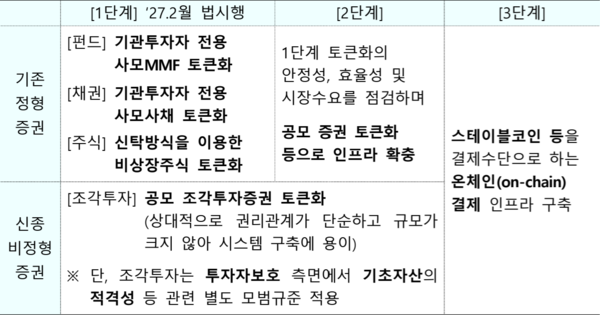
South Korea's financial authorities will expand tokenised securities (STO) beyond fractional investment to include existing securities such as stocks, bonds and funds. They will begin phased tokenisation from February 2027, starting with private funds for institutional investors, private bonds and unlisted shares, alongside implementation of the system in February 2027.
The Financial Services Commission held the third meeting of the public-private joint consultative body on tokenised securities on Thursday at the Korea Securities Depository's Seoul office. It announced its policy direction for tokenised securities.
Tokenised securities are securities issued and distributed on distributed ledgers such as blockchain. They were institutionalised in February through a revision to the Electronic Securities Act under the name "distributed ledger registered shares, etc," and the related law will take effect from Feb. 4, 2027.
The FSC said it will build infrastructure so that existing securities such as stocks, bonds and funds can be issued in token form, separate from fractional investment.
Phase 1 will begin in February 2027, when the law takes effect. For funds, it will promote tokenisation starting with private money market funds (MMF) for institutional investors, and for bonds, starting with private bonds for institutional investors. Stocks will be tokenised by placing unlisted shares in trust. Publicly offered fractional investment securities can also be issued in token form from Phase 1.
In Phase 2, it will review Phase 1 for stability and efficiency and assess market demand, then expand the scope of tokenisation to public offerings. In Phase 3, it will also pursue a plan to build on-chain settlement infrastructure by linking stablecoins and other means as settlement instruments.
It will also run a pilot programme to test the feasibility of tokenising listed shares, centred on the Korea Exchange. It plans to refer to pilot programmes by the New York Stock Exchange and Nasdaq in the United States.
It will also broaden the range of underlying assets for fractional investment products. It will allow pooling of multiple underlying assets if conditions are met, including that the assets are of the same type, that the standard and purpose of aggregation are clear, and that they do not include distressed assets.
It will also allow, if certain requirements are met, assets that may arise in the future, such as future receivables, to be used as underlying assets for fractional investment.
It will also put in place investor protection measures. For public offerings of beneficiary securities from non-monetary trusts, it presented as a standard example that the subscription limit per retail investor be set based on the characteristics of the underlying assets, with "the smaller amount of 30 million won and 5 percent of the issuance amount."
It will not create a separate licensing regime for financial investment businesses to handle tokenised securities. Securities firms or over-the-counter exchanges that already have a brokerage and dealing licence under the Capital Markets Act will be able to handle tokenised securities within the scope of their existing licence without additional approval.
However, an over-the-counter exchange must consult in advance with the Financial Supervisory Service to support trading in tokenised securities. It will also newly establish a licensing unit for an over-the-counter exchange for debt securities, following unlisted shares and beneficiary securities from non-monetary trusts.
The trading limit for retail investors on an over-the-counter exchange will be set at 100 million won in annual net purchases per exchange. It will also apply sanctions under the Capital Markets Act, including criminal penalties, administrative fines and account freezes, to unfair trading that occurs on over-the-counter exchanges.
It also detailed registration requirements for an "issuer account management institution," under which a non-financial company can directly manage accounts for tokenised securities it issues. It plans to set the minimum equity capital at 4 billion won and require 1 specialist in account management, 1 specialist in internal control and 2 information technology specialists.
The FSC plans to issue legislative notices by the end of September for revisions to subordinate regulations under the Capital Markets Act and the Electronic Securities Act. The revisions will include the scope of tokenised securities issuance, licensing units and trading limits for over-the-counter exchanges, and registration requirements for issuer account management institutions. The Korea Securities Depository and securities firms will begin building related infrastructure for Phase 1 implementation in February 2027.
Kwon Dae-young (권대영), vice chairman of the Financial Services Commission, said, "We will not allow tokenised securities to remain only in fractional investment." He said, "Through a strategic, phased approach, we will lay the foundation so that existing financial products such as stocks, bonds and funds can be issued and traded in a token-based manner."
He added, "We will connect the entire capital market value chain, including issuance, trading, clearing, settlement, exercise of rights, and underlying assets, from the perspective of a single digital capital market."
 Sangyeop Oh
yub@d-today.co.kr
Sangyeop Oh
yub@d-today.co.kr