
The Financial Industry Union said it opposes a uniform relocation of financial institutions as the government pushes a second phase of moving public institutions outside the capital. It said the government should first verify the effects of the first relocation phase, settlement conditions and staffing outflows, and then decide whether to relocate after considering the characteristics of the financial industry.
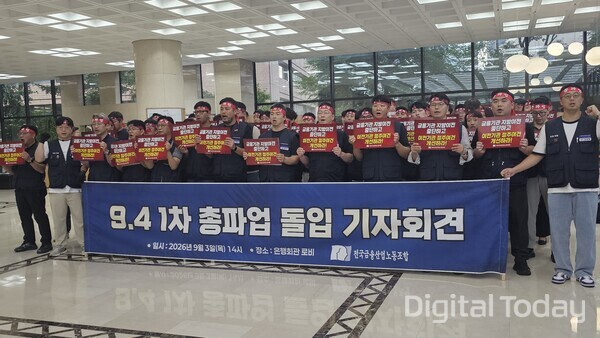
At a news conference on Sept. 3, the union said, "Before pushing ahead with the second relocation, we must first coolly evaluate how much the first phase eased concentration in the Seoul metropolitan area and what effects it had on regional economies."
The union stressed that in the financial industry, clustering and collaboration are important because companies, financial firms, policy lenders, regulators and professionals need to be close to exchange information and make quick decisions. It said the impact of dispersing financial institutions such as Korea Development Bank, Industrial Bank of Korea, Export-Import Bank of Korea and NongHyup to regions should be fully reviewed in terms of the financial industry and national competitiveness.
Ryu Jang-hee (류장희), head of the Industrial Bank of Korea union branch, also referred to the government’s announcement on relocation and said, "In a situation where Seoul has been developed into a financial hub to strengthen international financial competitiveness, relocating financial institutions in a uniform way could damage the achievements made so far." He also called for consultations with labour to be meaningfully reflected in the policy decision-making process.
The union also raised concerns about conditions at institutions that have already relocated. It said that even after the first phase, many employees still live apart from their families and travel long distances, and that difficulties in securing talent and staff outflows are continuing. It said the impact of the existing relocation policy should be checked before a second phase.
On how to pursue balanced regional development, it proposed that the approach should go beyond physically moving institutions and instead create a structure linking regional industry and finance with universities and jobs. It said a virtuous cycle should be built in which regional finance, including local banks, supplies funds to regional companies, self-employed small merchants and new industries while creating jobs for young people.
The union said it will begin its 'Sept. 4 first general strike' at 11 a.m. on Sept. 4 on Sejong-daero in Gwanghwamun. It said it plans to continue its struggle until key demands are met, including introducing a 4.5-day workweek, blocking the relocation of financial institutions outside the capital, expanding youth hiring and raising real wages.
 Ji-young Lee
ljy@d-today.co.kr
Ji-young Lee
ljy@d-today.co.kr