
With digital asset taxation set to begin next year, a claim has emerged that the current framework, which classifies both transfer and lending income as other income, should be revised. The argument is that income should be distinguished according to the economic substance of each transaction type, such as trading, mining and staking, and that tax infrastructure capable of linking transaction information from domestic and overseas exchanges with personal wallets should be put in place first.
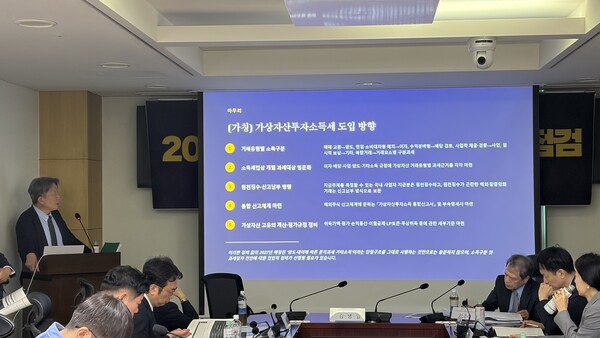
Park Jong-soo (박종수), a professor at Korea University School of Law and head of the Korean Association of Tax Law, said on Sept. 3 at the "Forum to Review the 2027 Virtual Asset Taxation System" held at the National Assembly Members' Office Building in Yeouido, Seoul, that there are still many items to review and prepare, including the income classification system, the enforcement infrastructure to support it and valuation methods for calculating tax amounts.
The forum was jointly arranged by the office of Democratic Party lawmaker Moon Jin-seok, the Digital Asset Exchange Alliance (DAXA) and the Korean Association of Tax Law.
Under the current Income Tax Act, income earned from transferring or lending virtual assets from Jan. 1, 2027 will be subject to separate taxation as other income. After netting annual digital asset trading gains and losses, 2.5 million won is deducted and income tax of 20 percent is levied on the remaining amount. The tax rate including local income tax is 22 percent. Taxpayers must file and pay for income generated in 2027 in May 2028.
Park said the current rules, which limit taxable items to transfers and lending, make it difficult to fully cover increasingly diverse digital asset transactions. He said buying and selling and exchanges could be included in transfers, but it is unclear whether mining, staking, liquidity provision, airdrops and hard forks fall under either transfers or lending.
He proposed as an alternative a tentative "virtual asset investment income tax" that reclassifies income based on the economic substance of transaction types. Under this approach, gains from buying and selling, exchanges and payments would be classified as capital gains, lending and deposit rewards as interest income, and profit-sharing rewards as dividend income.
He said repetitive, business-like mining should be treated as business income, while one-off rewards should be classified as other income. Transactions that combine multiple characteristics, such as staking or liquidity provision, should be taxed by splitting them into their components, he said.
Park said the tax system should be designed around the legal and economic functions of transactions rather than the names of specific blockchains, protocols or tokens. He said income with similar economic functions or taxpaying capacity should be taxed the same, and tax advantages and disadvantages stemming from transaction methods should be minimized as much as possible.
He also cited as a problem the difference in tax treatment between overseas digital asset exchange-traded funds (ETFs) and direct investment. Capital gains earned by domestic investors from trading overseas digital asset ETFs are taxed as capital gains from overseas stocks, while gains from directly trading digital assets are classified as other income.
He said fairness disputes could persist because capital gains for small shareholders in domestically listed stocks are in principle tax-exempt, while digital assets are taxed on annual income above 2.5 million won regardless of investment size.
Linking information for tax enforcement was also presented as a task. Because acquisition cost is calculated using the total average method by resident, investors using multiple domestic and overseas exchanges and personal wallets must collect all transaction histories themselves.
For assets held since before 2027, the acquisition cost is recognized as the larger of the market price on Dec. 31, 2026 and the actual acquisition cost. He said it is difficult to prove this if a trading market has not formed or if past transaction data are insufficient.
Park proposed applying withholding tax to transactions where the paying entity can be identified, and supplementing with final returns for transactions where it is difficult to specify the paying entity or where withholding is not realistically possible.
He also stressed that an integrated reporting system should be built in which businesses submit transaction statements and the National Tax Service verifies them afterward, similar to the reporting of capital gains from overseas stocks.
Panelists also said income classification by transaction type and improvements to tax infrastructure should move forward together.
Kim Gap-soon (김갑순), a professor in the accounting department at Dongguk University, explained that the background to classifying digital assets as other income included their classification as intangible assets under international accounting standards.
But he said digital assets, unlike trademarks and patents, are traded repeatedly and have high price volatility, making it difficult to view their economic substance as the same. He said income should be determined based on transaction structure and economic control rights.
Kim Kyung-ha (김경하), a professor in the finance, accounting and tax department at Hanyang Cyber University, proposed setting up a standardized data system so that when digital assets move between exchanges or personal wallets, information such as acquisition time, acquisition cost and incidental expenses can be transferred together.
She said because it is harder for tax authorities to capture information on transactions through overseas exchanges and personal wallets than on domestic exchanges, supplementary measures are needed so that the tax burden does not concentrate on domestic users.
Kim Tae-kyung (김태경), a legislative researcher at the National Assembly Research Service, said capital gains from digital assets are classified as other income and are therefore excluded from the carryover taxation on capital gains that applies to gifted assets between spouses or lineal ascendants and descendants. Kim said authorities should check before the tax takes effect whether there is any possibility of tax avoidance through gifts among family members.
 Oh Sang-yup
yub@d-today.co.kr
Oh Sang-yup
yub@d-today.co.kr