
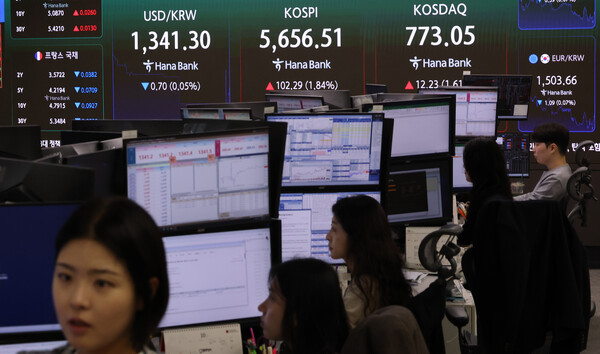
The government will strengthen real-time joint monitoring after volatility in the domestic stock market has widened sharply. It will also check whether stock market instability is spreading to the bond, foreign exchange and short-term money markets. It plans to respond strictly to acts that disrupt the market.
The government on Oct. 16 held a joint meeting at the Government Complex Seoul to review market conditions, discussing trends in domestic and global financial markets and directions for future responses.
The meeting was chaired by Kwon Dae-young (권대영), first vice finance minister, and attended by Heo Jang (허장), second vice finance minister; Kwon Min-soo (권민수), deputy governor of the Bank of Korea; Lee Se-hoon (이세훈), senior deputy governor of the Financial Supervisory Service; and Shin Jin-chang (신진창), secretary-general of the Financial Services Commission.
The government and related agencies assessed that volatility and uncertainty in financial markets have increased due to external factors such as U.S. Treasury yields, business conditions in AI and semiconductors, and geopolitical tensions in the Middle East.
They said expectations of rising global interest rates, uncertainty over investment and profitability in the AI semiconductor sector, and risk-off sentiment driven by higher international oil prices have served as the backdrop to recent corrections in stock markets at home and abroad.
They assessed that the domestic stock market is showing relatively large volatility compared with other markets due to differences in market weighting among major sectors.
They maintained their assessment that the underlying fundamentals of the domestic economy and stock market are solid. The government explained that economic growth in the 3 percent range is expected this year, the current account is posting a large surplus, and corporate earnings forecasts are also showing up favorably.
The government plans to jointly check domestic and global financial market conditions in real time and analyze risk factors. It plans to manage them in an integrated way by considering not only individual markets but also linkages between markets and spillover effects.
It will also continue institutional improvements aimed at lowering volatility and increasing growth potential in the domestic capital market. Through this, it plans to raise market credibility and competitiveness.
Whether abrupt moves in stocks spread to other financial markets will also be a key monitoring item. The government decided to closely examine the impact of stock market fluctuations on the bond, foreign exchange and short-term money markets.
It will also strengthen surveillance of unfair and disruptive acts that exploit market instability. The government and related agencies plan to continuously check market conditions through joint monitoring and respond strictly if market-disrupting acts are confirmed.
 Sang-yeop Oh (오상엽)
yub@d-today.co.kr
Sang-yeop Oh (오상엽)
yub@d-today.co.kr