
8 out of 10 domestic AI companies are feeling a significant regulatory burden from consent requirements for collecting and using personal information, a survey showed. South Korea's level of friction from personal-information data regulation was also found to be the highest among 48 jurisdictions worldwide, tied with China.
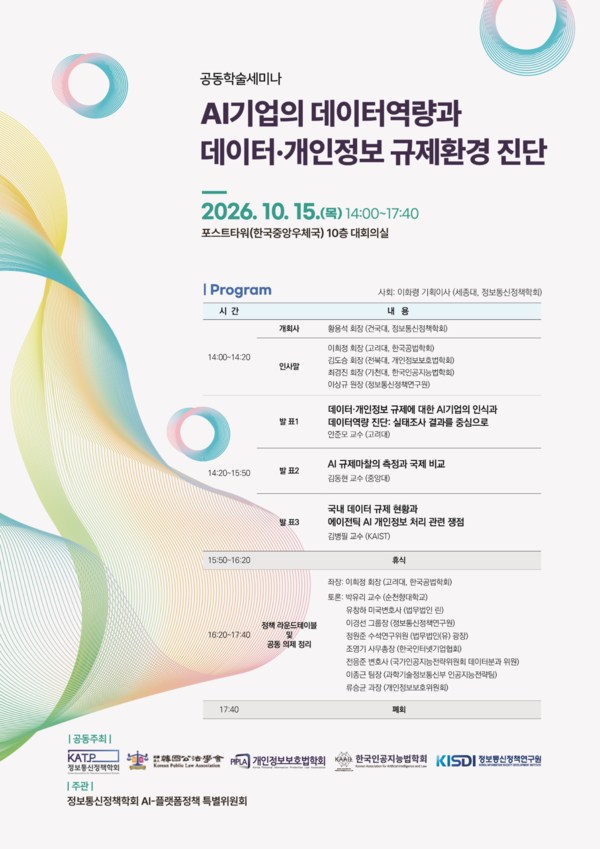
The Korean Society for Telecommunications Policy, the Korean Public Law Association, the Personal Information Protection Law Association, the Korean Artificial Intelligence Law Association, and the Korea Information Society Development Institute (KISDI) said on Oct. 14 they will hold a joint academic seminar on Oct. 15 at Post Tower in Seoul titled "Assessing AI companies' data capabilities and the data and personal information regulatory environment."
The seminar will disclose results comparing domestic AI companies' perceptions of data regulation with regulatory environments in major countries. It will discuss institutional improvements to secure both personal information protection and competitiveness in the AI industry.
According to a "2026 survey on AI companies' perceptions of data regulation and the state of competitiveness," to be presented by Professor Jun-mo Ahn (안준모) of Korea University, 26 of 33 respondent companies, or 78.8 percent, said the burden of complying with consent requirements for collecting and using personal information is high. It was the highest share among 11 regulations surveyed. It was followed by "sanctions, penalty surcharges and liability provisions" at 75.8 percent, and "restrictions on use for purposes other than the original purpose" at 72.7 percent. The most common reason for not trying to secure necessary data was "uncertainty over whether it is legally permitted," at 48.5 percent.
Data regulation was also found to have affected actual business. Over the past 12 months, 13 of 34 companies saw service launches delayed or projects halted or scaled down due to data issues. Because of the regulatory burden, 6 of 33 companies also reviewed or carried out abandoning domestic launches of certain services.
In an expert survey, predictability in regulatory enforcement was cited as a key problem factor. Some 85.2 percent of experts assessed the compliance burden from sanctions, penalty surcharges and liability provisions as high. By contrast, only 11.3 percent said regulators' judgments are consistent on similar cases.
An international comparative study to be presented by Professor Dong-hyun Kim (김동현) of Chung-Ang University also showed South Korea's burden from personal-information data regulation stands out.
Researchers compared regulatory environments in 48 jurisdictions, including 18 U.S. states, as of Aug. 27 this year. South Korea's personal-information data regulation friction score was 70.4 on a 100-point scale, the highest along with China. It was also higher than the 63.0 score for European Union member states.
By contrast, South Korea's general AI regulation score was 40.7, and its enforcement and uncertainty score was 55.6, both lower than the EU average. Researchers said South Korea's relative regulatory burden is concentrated in the area of using personal-information data. They proposed reducing procedural burdens in the use of pseudonymised information and data combination, and clarifying criteria for judgments on database rights and commercial AI training.
The seminar will also address personal information protection issues arising from the spread of agentic AI. Professor Byung-pil Kim (김병필) of KAIST will present on "the development of agentic AI and challenges for personal information protection law and policy." A policy roundtable will also be held, chaired by Hee-jung Lee (이희정), president of the Korean Public Law Association, with participation from academia, industry and government officials.
 Jin-ho Lee
jhlee26@d-today.co.kr
Jin-ho Lee
jhlee26@d-today.co.kr