
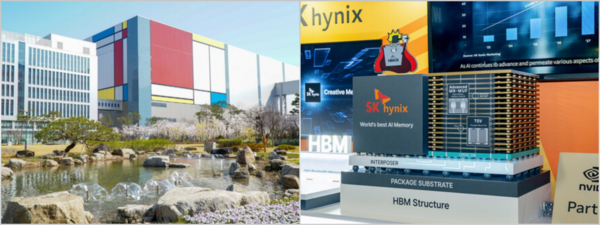
Samsung Electronics and SK Hynix shares have fallen by amounts comparable to the foreign exchange and financial crises despite upcoming record results. Even without any direct bad news for the two companies, worries over funding at U.S. AI data center operators and concerns about U.S. rate hikes spread into doubts about memory demand, dragging down the shares. With stocks having rebounded within a year after past sharp drops, an assessment says this time the timing of a rebound will be determined by when concerns over AI data center financing ease, given earnings support.
Samsung Electronics shares began falling from the 6th and declined every day except on the 14th. The Oct. 15 close was 24.8 percent lower than the close on the 2nd, before the slide. SK Hynix fell for seven straight sessions over the same period, dropping 32.8 percent, and it lost 12.76 percent on Oct. 15 alone, the biggest one-day fall during the period. Both shares edged up on the 16th, but were far from recouping the losses.
Since 1990, Samsung Electronics shares have fallen this much in a week only five times, including this time. The previous four were during the 1997 and 1998 foreign exchange crisis, the 2000 dot-com bubble collapse and immediately after Lehman Brothers' bankruptcy in 2008. In 2000, when the weekly decline was the largest, the stock fell 22.3 percent. Even during the COVID-19 period in March 2020, Samsung Electronics' biggest weekly fall was 11.6 percent. It is the first time such a drop has occurred without an economic crisis.
The companies' earnings run counter to the share drop. Samsung Electronics' preliminary third-quarter operating profit was 10.74 trillion won, up 20 percent from the previous quarter. Hana Securities estimated SK Hynix's third-quarter operating profit at 7.79 trillion won. They earned profit reaching 18 trillion won from memory alone.
There are indirect factors behind the decline. They can be found in funding conditions at U.S. AI data centers. CoreWeave buys Nvidia GPUs to build data centers and rents out the computing power to AI companies, and it has financed a significant portion of investment with debt. It is where memory from Samsung Electronics and SK Hynix is installed.
CoreWeave shares fell 15.46 percent on Oct. 14 local time. On the same day, yields on CoreWeave corporate bonds maturing in 2032 rose to near 15 percent. That means bond investors have started to see a greater risk of not getting their principal back. In addition, U.S. September producer price index data exceeded expectations, heightening concerns the Fed may raise rates further, which became a burden for companies that have been increasing investment with debt. On Oct. 15 in the Korean market, the two companies' shares recorded their biggest drops of the week.
Funding problems at U.S. data center operators have spilled over to the share prices of domestic memory companies because AI data center computing cannot run without memory. Nvidia GPUs use high-bandwidth memory (HBM), and servers use DRAM as well. Nvidia is a shareholder with a 10 percent stake in CoreWeave and also a GPU supplier.
The view reflected in share prices is that if companies like CoreWeave find it harder to borrow, GPU orders will fall and demand for SK Hynix and Samsung Electronics, which make HBM and DRAM, could be shaken. That is also seen as why the decline was larger for SK Hynix, which has a higher memory exposure. The fact that Taiwanese and Japanese semiconductor shares fell even though TSMC posted third-quarter revenue above market expectations is read as a sign that the market is again scrutinising financing that supports AI investment.
If past sharp declines stemmed from economy-wide crises such as the foreign exchange crisis and the financial crisis, there is still expectation this time. After each of the four previous sharp drops, Samsung Electronics shares rebounded. After four weeks, the stock was higher than immediately after the drop in all four cases.
The earnings outlook is also good. Hanwha Investment & Securities picked HBM4 as the core driver of Samsung Electronics' earnings growth next year. Hana Securities expected SK Hynix to announce additional shareholder returns of at least 3 trillion won in its third-quarter earnings release. As demand for the HBM comes from AI data centers that have now seen funding concerns flare up, an assessment says the timing of a share rebound will be determined by financing conditions for AI data centers.
 Daegeon Seok
d2dg@d-today.co.kr
Daegeon Seok
d2dg@d-today.co.kr