
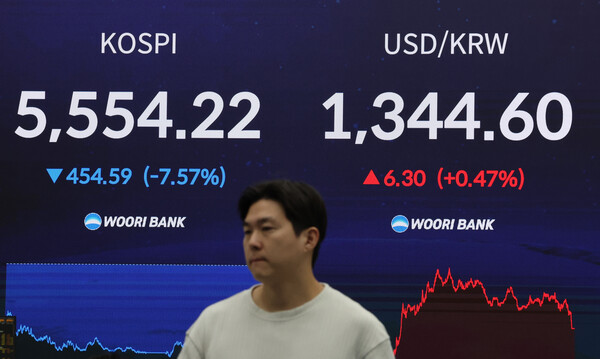
South Korean stocks plunged again. The KOSPI fell more than 9 percent intraday, sliding to the 5,400 level, while the Kosdaq dropped more than 7 percent. Sell-side sidecars were triggered in both markets, followed by circuit breakers.
On Oct. 15, the KOSPI ended down 454.59 points, or 7.57%, at 5,554.22. The point fall and percentage drop were the biggest in about two and a half months since July 28, when the KOSPI plunged 10.84%. The index fell 732.09 points that day.
Compared with historical records, the day's percentage fall did not reach a record high. On March 4 this year, the KOSPI slumped 12.06% for its biggest-ever percentage drop, and it fell 10.84% on July 28 as well.
Still, a fall in the 7% range is an unusually large one-day drop, comparable to moves seen during the financial crisis or the COVID-19 shock.
The KOSPI opened at 5,673.01, down 335.80 points, or 5.59%, from the previous close of 6,008.81. Losses deepened early in the session. In the afternoon it fell to as low as 5,450.81, bringing the decline to 9.29%. It later pared some losses to finish in the 5,500 range.
Foreign selling persisted. Foreign investors posted net sales of 3.62 trillion won on the main board. Retail and institutional investors were net buyers of 1.29 trillion won and 1.69 trillion won, respectively.
Most top stocks by market value tumbled. Samsung Electronics closed down 9.48% at 210,000 won, and SK Hynix slumped 11.06% to 1,262,000 won.
SK Square fell 10.21%, Samsung Electro-Mechanics dropped 15.36%, Hyundai Motor lost 5.74%, Samsung Life fell 7.51%, LG Energy Solution slipped 4.62% and KB Financial Group declined 1.57%.
Samsung Biologics rose 5.50% to 1,247,000 won, the only gainer among the top stocks by market value.
Volatility controls in both markets were activated in sequence as stocks plunged. Sell-side sidecars were triggered in the KOSPI and Kosdaq early in the session. Level-one circuit breakers were then triggered at 12:23:13 p.m. in the Kosdaq and at 12:38:12 p.m. in the KOSPI. Trading was halted for 20 minutes in each case.
It was the first time since July 29 that circuit breakers were triggered in both the KOSPI and the Kosdaq on the same day. It marked the fifth time this year that circuit breakers were activated simultaneously in the two markets.
The Kosdaq ended down 63.06 points, or 7.65%, at 760.82. It fell more than 8 percent intraday, with volatility surging enough to trigger a circuit breaker.
The won-dollar exchange rate was 1,342.50 won, down 0.50 won from the previous session.
South Korean stocks have recently undergone a sharp correction as concerns over investment profitability in the artificial intelligence (AI) industry combined with weakness in U.S. technology and semiconductor stocks and worries over increased supply by Chinese memory makers. The KOSPI has fallen for 7 straight sessions from Oct. 6 through Thursday, dropping 1,449.52 points, or about 21%, over the period.
Han Ji-young (한지영), a researcher at Kiwoom Securities, analysed that while there is a possibility of technical buying following the recent string of sharp declines, severely weakened investor sentiment could limit any rapid reversal of the index's downtrend based solely on bargain hunting driven by oversold conditions or valuation appeal.
Kim Sung-geun (김성근), a researcher at Mirae Asset Securities, said high volatility was likely to continue for some time. He said that with domestic supply-and-demand conditions weakening and the external environment unlikely to improve in the short term, investors need to closely check the macro environment and changes in corporate earnings.
 Sangyeop Oh
yub@d-today.co.kr
Sangyeop Oh
yub@d-today.co.kr