
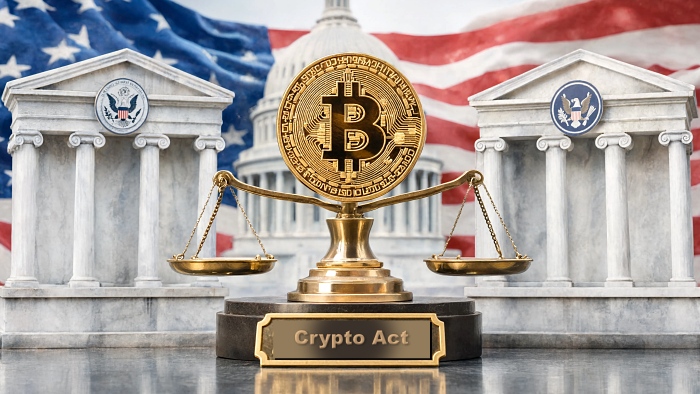
Prospects for passing this year the market-structure bill known as the Clarity Act, the top legislative priority the U.S. crypto industry has pursued this year, have been shaken sharply in September.
On Sept. 1, CNBC reported that pessimism is spreading in the industry that it may be difficult to process the bill within 2026. The Clarity Act lays out a regulatory framework for the crypto market and splits digital asset oversight authority between the Securities and Exchange Commission and the Commodity Futures Trading Commission. It also includes registration requirements for crypto companies and anti-money laundering rules, and is seen as a core bill for regulatory standards the industry has sought for years.
The Senate was unable to hold a full vote before the August recess. Senate Republican Leader John Thune (존 튠) indicated a procedural vote to begin consideration of the bill on Sept. 15, shortly after lawmakers return. That is not a final passage vote, and floor consideration and further negotiations would remain. Issues include stablecoin reward provisions and ethics clauses surrounding President Donald Trump and his family's crypto interests.
Democratic Senator Ruben Gallego (루벤 가예고) of Arizona said at the Wyoming Blockchain Symposium that to get 60 votes, remaining issues must be settled along with appropriate ethics-related provisions, and that bipartisan agreement must come first. John Darsie (존 다시), chief executive of SALT, also told CNBC that he is personally somewhat pessimistic about passage and that bills of this scale do not often pass ahead of midterm elections.
The uncertainty contrasts with the money the crypto industry poured into politics during the 2024 presidential election. The industry and related political groups spent more than $200 million, or about 280 billion won, in the 2024 election to back the election of pro-crypto candidates, and used that as a foothold to drive a shift in Washington's regulatory stance.
Even if the bill fails, expectations that the industry will face an immediate hit are relatively weak.
Since the launch of the Trump administration, the SEC and CFTC have shown a friendlier regulatory stance than before, and other financial regulators such as the Office of the Comptroller of the Currency have also been moving to ease digital asset regulation. Trump also said at a crypto summit in August that the government is focusing on establishing a "clear regulatory framework for pioneers and developers."
Some also see that even without a comprehensive market-structure law, rulemaking by the SEC and CFTC could reduce some uncertainty. Sunayna Tuteja (수나이나 투테자), former chief innovation officer at the U.S. Federal Reserve, said the two agencies are discussing options through rulemaking and called it "not perfect, but still progress." Denelle Dixon (디넬 딕슨), head of the Stellar Development Foundation, also argued that over the next 2 years the industry should use existing regulations to create precedents that can be maintained under the next administration.
Some point out that a clear regulatory framework based in law is needed for long-term capital investment.
Andrew McCormick (앤드루 매코믹), head of institutional and market development at Chainlink Labs, said that unlike jurisdictions with established regulatory systems, markets such as the United States where policy can swing sharply every 2 to 4 years make capital allocation difficult. That means laws that remain in place even when the administration and congressional power change would make it easier for companies and investors to commit funds over the long term.
Political variables also remain. Former New York Governor Andrew Cuomo (앤드루 쿠오모), an OKX board member, warned that if the Clarity Act does not pass before the midterm elections and Democrats retake the House of Representatives, regulatory conflict between Congress and the Trump administration could be prolonged.
The Senate procedural vote scheduled for Sept. 15 is expected to be an important watershed for the industry's push for mainstream acceptance. Passage of the bill is clearly the industry's top goal, but even if it fails, the industry is already preparing ways to continue operations by using the current regulatory system and SEC and CFTC rulemaking.
 Seung-ah Yoo
ysah@d-today.co.kr
Seung-ah Yoo
ysah@d-today.co.kr