
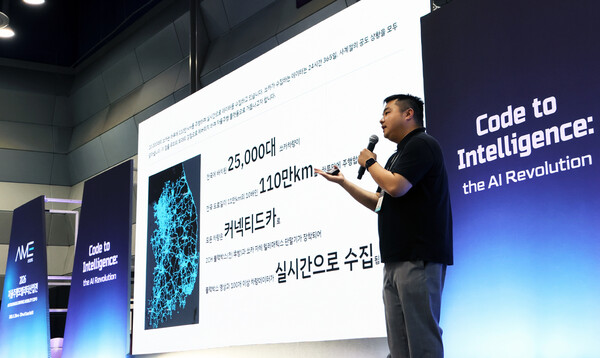
[DigitalToday reporter Dae-geon Seok] The autonomous driving industry is shifting from rules-based systems to data-centric approaches. Apex Mobility, a specialist in autonomous driving, said on Aug. 28 that its chief strategy officer, Jang Hyuk (장혁), gave a presentation on “a data platform for commercialising autonomous driving services” at the 2026 Autonomous Driving Industry Conference held at COEX in Seoul’s Samseong-dong on Aug. 27.
Apex Mobility is Socar’s autonomous driving technology unit under its car-sharing platform. In May, Socar set up Apex Mobility as an autonomous driving joint venture worth 150 billion won in total. Apex Mobility plans to expand in stages from building and supplying data pipelines to an autonomous-driving-based robotaxi ride-hailing service.
In the presentation, Jang put the golden time for South Korea’s autonomous driving market at up to 3 years. He said commercial unmanned autonomous driving services in the United States and China are on track and projects are also under way in major cities such as London and Tokyo.
He stressed that autonomous driving technology is shifting from a rules-based approach relying on high-resolution precision maps to an end-to-end approach that processes video and lidar inputs in a single AI model. Jang said edge-case data capturing accidents and unexpected situations is becoming the last barrier to advancing autonomous driving as open-source VLA, meaning vision-language-action models, becomes widespread.
“The first stage of the roadmap for service commercialisation is turning the data assets that our parent company Socar has accumulated over the past 15 years of running its car-sharing business into a form that autonomous driving AI can simulate,” Jang said.
The second stage is securing high-quality data for AI training. Apex Mobility unveiled for the first time at the exhibition a prototype Ioniq 5 vehicle equipped with lidar and 7 omni-directional cameras. The final stage is to link the competitiveness of the country’s largest data platform to autonomous driving services.
Apex Mobility is also preparing route-based and demand-responsive robobuses with the goal of a Level 4 technology-based autonomous ride-hailing service. Socar plans to introduce Level 2+ autonomous driving vehicles at about Level 3 into car-sharing, with the two companies splitting responsibilities between car-sharing and ride-hailing.
“Socar and Apex Mobility aim to grow into a national representative autonomous driving mobility service provider that spans car-sharing, where a driver sits in the driver’s seat, and ride-hailing, where AI fully drives autonomously,” Jang said.
 Dae-geon Seok
d2dg@d-today.co.kr
Dae-geon Seok
d2dg@d-today.co.kr