
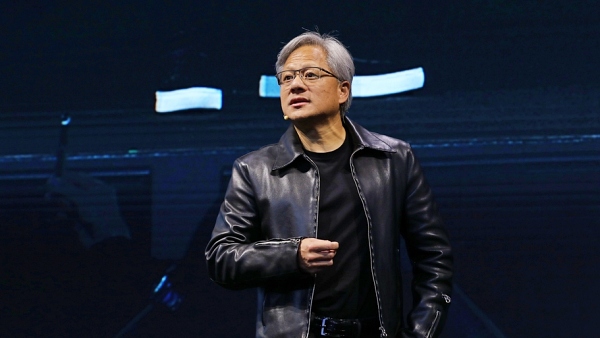
Jensen Huang (젠슨 황), Nvidia's chief executive, said on an earnings conference call that Nvidia has already reached artificial general intelligence, or AGI, by the standards of many tasks.
The Verge reported on Aug. 27 that he simultaneously dismissed various milestones around AGI as "somewhat meaningless" at this point.
Asked about OpenAI's pursuit of AGI, he said, "When it comes to many tasks, we can say we have already achieved AGI." He did not present a precise definition of AGI or criteria for making that judgement. Instead, he said AI is moving beyond simply responding to prompts and toward autonomous agents that learn new skills on their own and repeatedly improve.
He stressed business performance rather than declaring AGI itself. He said what matters is whether AI does "productive and useful work" and produces "profitable tokens." As computing power increases, more tokens are generated and ultimately lead to more revenue, he said. He viewed the market as having reached this stage, leading companies to be more proactive in investing in AI infrastructure.
This is not the first time he has mentioned achieving AGI. He said on the Lex Fridman (렉스 프리드먼) podcast in March, "We think we have achieved AGI." He did not offer specific criteria then either. Later in the conversation, he narrowed the scope of his remarks, saying the chance that 100,000 AI agents could directly found and run a company like Nvidia was "0 percent."
The remarks again exposed broader industry ambiguity around AGI. Big tech and the AI industry have described AGI as human-level or higher general intelligence, but there is no agreed definition of intelligence itself. As a result, there is wide variation in what AGI must satisfy and when it can be considered achieved.
OpenAI is no exception. OpenAI defines AGI in its charter as "a highly autonomous system that outperforms humans at most work of economic value." But OpenAI CEO Sam Altman (샘 알트먼) last year acknowledged AGI is "not a very useful term." OpenAI is also reported to have separate finance-focused criteria drawn up with Microsoft, under which a system that can generate at least $100 billion in profit would qualify. More recently, OpenAI Chief Research Officer Mark Chen (마크 첸) said OpenAI is "80 percent" of the way to achieving AGI, and Altman said that by the end of this year he could produce something he would call AGI.
Anthropic CEO Dario Amodei (다리오 아모데이) also called AGI an "inaccurate" expression and a "marketing term," saying he prefers the term "powerful AI" instead. Meta uses "personal superintelligence," Microsoft uses "humanist superintelligence," and Amazon uses "useful general intelligence." Google DeepMind CEO Demis Hassabis (데미스 허사비스) has used the phrase "the beginning of the singularity." The industry keeps putting forward new terms, but it has not made standards any clearer, critics say.
Ultimately, the remarks again show that AGI is a loose concept used differently by each company rather than a technical endpoint. Nvidia focused on real-world task performance and the potential for monetisation rather than the debate over AGI's definition. In this situation, debate is expected to continue over what the key metrics in the AI race are and what criteria companies will use when they employ the term AGI.
 Seung-a Yoo
ysah@d-today.co.kr
Seung-a Yoo
ysah@d-today.co.kr