
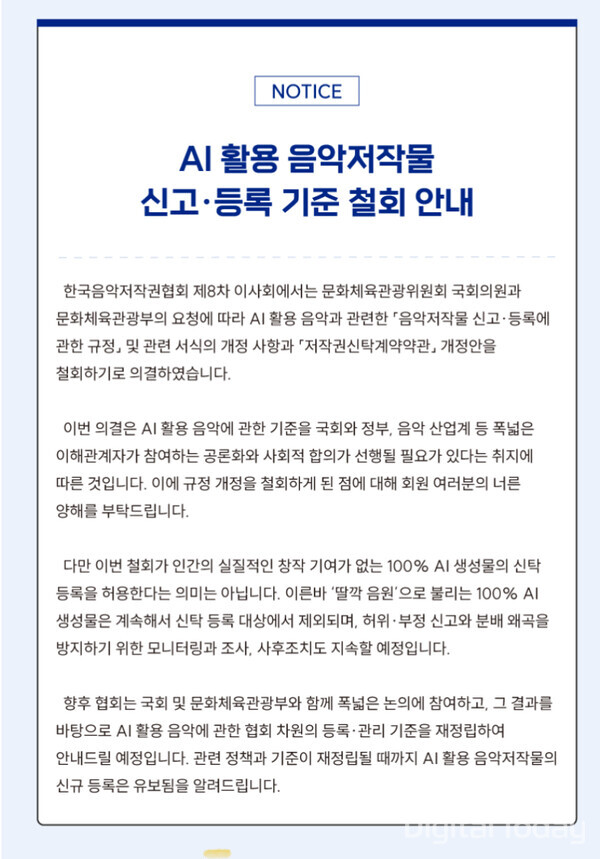
AI-generated music is spreading quickly, but domestic standards for recognising copyrights remain unclear. The Korea Music Copyright Association drew up its own standards for registering and managing AI music, then withdrew them about 3 weeks after implementation. Uncertainty in the industry over copyright registration and distribution and settlement of royalties is also expected to continue for the time being.
According to the industry on Aug. 28, the association recently voted at its eighth board meeting to withdraw revisions to its rules and related forms on reporting and registering musical works involving AI, as well as a revised draft of its copyright trust contract terms and conditions.
The association drew up the standards as generative AI rapidly became an actual production tool in the music industry. Cases have increased not only of services generating entire songs with AI, but also of using AI in parts of the production process such as lyrics and composition, arrangement, and mixing and mastering. That made it difficult to restrict registration of works simply because AI was used.
The association accordingly set standards at its seventh board meeting last month allowing trust registration of AI-used music in which humans contributed to creation in a "substantial and leading" manner.
Creators were required to report the areas and tools where AI was used, how it was used, and what creative work humans performed directly. The rules also set a basis for the association, if necessary, to technically verify the creative process or conduct internal review.
By contrast, so-called "one-click tracks" generated solely by entering prompts without substantial human creative contribution were excluded from trust registration.
It also sought to strengthen sanctions for false or improper reporting. The association prepared a revised draft of its trust contract terms and conditions that included confirmation and warranty obligations for AI-used works and, if problems are confirmed, provisions to withhold collection and distribution of copyright royalties or terminate the trust contract, and apply refunds of royalties and penalties.
However, the rules were withdrawn after opposition from Kim Jae-won (김재원), a lawmaker from the Rebuilding Korea Party on the National Assembly Culture, Sports and Tourism Committee, and the Ministry of Culture, Sports and Tourism. The aim was that the copyright nature of AI music and the scope of rights recognition should be set through public discussion and social consensus involving the government, parliament and the music industry, rather than being determined preemptively by individual trust management organisations. The association decided to suspend new registrations until a new management system is prepared.
PRIVATE STANDARDS BLOCKED, BUT NO REPLACEMENT LAWS OR SYSTEMS
The current Copyright Act defines copyrighted works as "creative works that express human thoughts or emotions," and does not recognise AI itself as an author. Parts of outputs created using AI can be protected if humans contributed creatively. But detailed standards for judging how much contribution counts as creation that gives rise to copyright have not yet been set.
A "copyright registration guide for works using generative AI" published last year by the Korea Copyright Commission also advises applicants registering AI-used works to distinguish the AI program and prompts, the role of AI outputs, and parts created directly by humans. But how to apply that to registration, distribution and settlement in the music industry remains unclear.
Choi Ji-eun (최지은), a professor at Kyung Hee University's Graduate School of Art Fusion Design, said, "It is difficult to treat AI-used works exactly the same as works made by humans." She said that to manage them within the current system, it is necessary to establish separate standards based on the degree of AI use, referring to options such as setting differences in rights ownership or protection periods as with works made for hire.
OVERSEAS TRUST AND MANAGEMENT BODIES RUN THEIR OWN AI REGISTRATION STANDARDS
Overseas, music copyright trust and management organisations operate their own registration standards for AI-used music. The American Society of Composers, Authors and Publishers, Broadcast Music, and the Society of Composers, Authors and Music Publishers of Canada recognise AI-used music that includes human creative contributions as eligible for registration, while excluding 100 percent AI-generated works with no substantial human involvement.
The basic direction is similar to the standards the Korean association had pursued. BMI also allows registration when AI creates accompaniment or a harmonic structure and people participate in lyrics, melody and arrangement, and does not accept music completed solely by entering prompts. Under the legal principle of human creation, management bodies that handle actual registration and distribution set detailed standards.
In South Korea, by contrast, concerns are being raised that uncertainty for generative music businesses could grow as such detailed standards disappear.
An industry official said, "If regulatory standards are unclear, legal review is needed every time a contract is made, and the related costs inevitably increase." The official added, "From a business operator's standpoint, it is rather more flexible to respond if the trust manager has clear standards and manages it within the existing system."
 Seulgi Son
sageson@d-today.co.kr
Seulgi Son
sageson@d-today.co.kr