
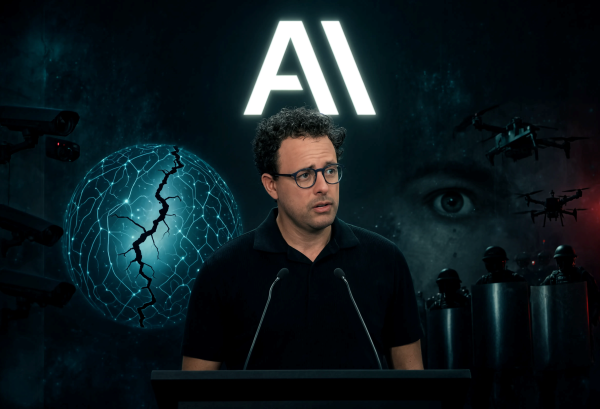
[DigitalToday intern reporter Seungah Yoo] Dario Amodei (다리오 아모데이), CEO of Anthropic, acknowledged a crisis in the artificial intelligence industry. He said the industry has fallen into a trust crisis because AI has not proved social benefits.
On Aug. 26, TechRadar reported that Amodei wrote on X, formerly Twitter, that distrust stems from people feeling governments and companies are using AI in ways that work against them.
Amodei called the most accurate criticism of AI companies, including Anthropic, that they have not yet delivered on big promises to help the world. He said the industry is losing trust because it has not shown promised benefits in real results. He said an ad claiming AI can cure cancer would not be persuasive, adding that what works is actually curing cancer.
The remarks align with a trend in which AI has been used with an emphasis on management efficiency and cost-cutting logic rather than direct user benefits. Major AI companies, in their early efforts to persuade executives to invest, put workforce cost savings and the possibility of replacing work at the forefront. Amodei has previously said AI could eliminate 50 percent of white-collar jobs, but later changed his wording to describe AI as a "multiplier effect" that increases output.
Amodei mentioned a future focus on biology and medicine. He said Anthropic is expanding efforts to use AI in biology and medicine while stressing related moral standards. He also noted there are criticisms that visible results have not yet been sufficiently presented.
He also raised issues of regulation and concentration of power. Amodei argued there needs to be balance among regulation, oversight, testing and open-weight models. He said he sympathises with some claims of the "Pacing the Frontier" movement, adding that introducing controls on frontier labs could moderate the pace of technological development while buying time for other industry participants to catch up.
Distrust of AI is growing more in its actual deployment areas than in the technology itself. In the United States, AI is being widely deployed in surveillance infrastructure and public security systems. Anthropic participated in a Defense Department AI procurement project until its relationship with the Pentagon was severed, but it did not cooperate in having its technology used for mass surveillance and fully autonomous weapons and ultimately lost the contract. OpenAI later signed a new contract with the Pentagon to fill the gap. OpenAI drew a line by saying it bans the use of its technology to surveil Americans.
Backlash against private surveillance systems is also growing. Flock, which operates AI cameras that track vehicle licence plates, has faced broad resistance. The system was originally introduced to track suspect vehicles across borders and jurisdictions, but claims have been raised of misuse by law enforcement personnel to track ex-partners, colleagues or people of interest.
Similar controversies continue in traffic enforcement. AI-based traffic surveillance and speed cameras have faced issues such as misreading licence plates or configuration errors, and critics have said that in cases where citations were issued to the wrong vehicle, the accused must prove innocence in court. That has raised concerns the principle in U.S. criminal cases that the government must prove a crime could be overturned.
Palantir's AI technology was presented as a case where such concerns concentrate. Palantir supplies AI to the U.S. military and law enforcement agencies, and U.S. Immigration and Customs Enforcement uses the technology to track suspected illegal immigrants. It is also used for drone video analysis, long-range precision strikes, military data analysis and operational planning.
The remarks ultimately show the AI industry has entered a phase of being judged by real benefits and how it is used, beyond competition over technical performance. It is expected to remain a key issue how the industry addresses concerns over use in surveillance, policing and military areas, as emphasising productivity gains or future potential alone will make it difficult to restore trust.
 Seungah Yoo
ysah@d-today.co.kr
Seungah Yoo
ysah@d-today.co.kr