
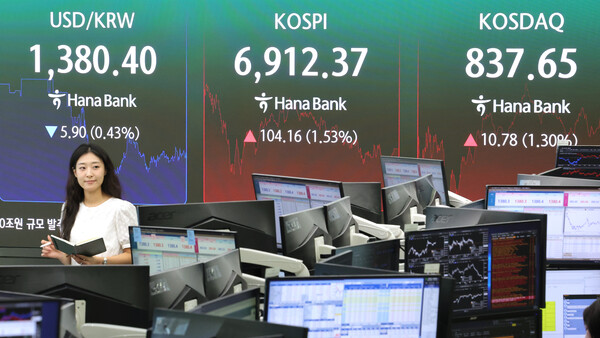
KOSPI rose for a third straight session on joint net buying by foreign and institutional investors and strength in semiconductor shares. It climbed to just below the 7,000 level early in the session, but pared gains after the Bank of Korea announced a benchmark rate hike and ended around the 6,910 level.
On Aug. 27, KOSPI ended up 104.16 points, or 1.53 percent, at 6,912.37. The index opened up 187.91 points, or 2.76 percent, at 6,996.12 and tried to break above 7,000 during the session. It later slid to the 6,800 level before recovering part of the drop.
KOSPI's gains narrowed shortly after the Bank of Korea's Monetary Policy Board announced it would raise the benchmark interest rate by 0.25 percentage point to 3.00 percent from 2.75 percent. The market was seen as turning more volatile during the session as liquidity 부담 from the rate hike came into focus.
In the main board market, foreign investors posted net purchases of 135.4 billion won. Institutions also bought a net 181.4 billion won. Retail investors were net sellers of 1.91 trillion won.
Large-cap semiconductor shares rose in tandem as investor sentiment improved on strong Nvidia earnings. Samsung Electronics ended up 1.72 percent at 266,000 won and SK Hynix gained 2.49 percent to close at 1,730,000 won.
Elsewhere, SK Square rose 0.95 percent, Samsung Electro-Mechanics gained 4.14 percent and LG Energy Solution advanced 5.56 percent.
Hyundai Motor fell 2.45 percent, Samsung C&T dropped 3.10 percent, and Samsung Life Insurance and Samsung Biologics slipped 0.81 percent and 0.31 percent, respectively.
KOSDAQ also rose. The index ended up 10.78 points, or 1.30 percent, at 837.65.
In Seoul's foreign exchange market, the won was at 1,381.20 per dollar, 4.80 won firmer than the previous session.
Earlier, Nvidia reported second-quarter results that beat market expectations. Revenue came to $96.2 billion, above a market forecast of $92.2 billion, while data centre revenue was $89.0 billion, topping an expected $85.8 billion. This was seen as improving investor sentiment toward South Korea's semiconductor sector.
Han Ji-young (한지영), an analyst at Kiwoom Securities, said Nvidia's results boosted visibility for demand for memory such as HBM and DRAM and strengthened memory makers' pricing power. He also said investor sentiment toward semiconductors, which had been the leading stocks and had seen elevated anxiety for some time, was expected to enter an improving phase.
 Sangyeop Oh
yub@d-today.co.kr
Sangyeop Oh
yub@d-today.co.kr