
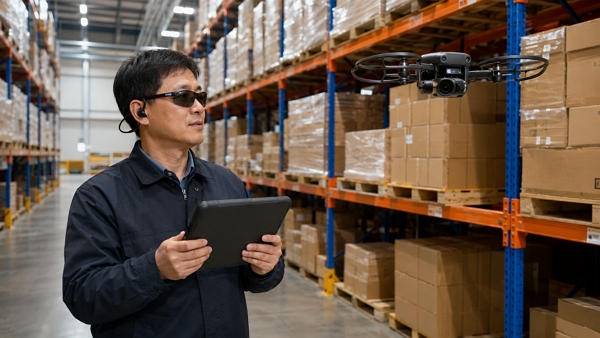
As it becomes harder to secure staff at U.S. logistics warehouses, a new way of using labour that combines employment of visually impaired people with AI assistive technology is drawing attention. Drones, smart glasses and screen-reading technology are lowering the barrier to warehouse work that previously relied heavily on vision.
On Aug. 26, local time, IT outlet Business Insider reported that Bosma Enterprises in Indiana uses AI drones, Meta smart glasses, screen magnification software and screen readers to support logistics and inventory work for visually impaired employees. The company, where more than half of staff are visually impaired, also said it employs the most visually impaired people in Indiana.
The backdrop is labour demand in logistics. The U.S. Bureau of Labor Statistics said job openings in transportation, warehousing and utilities totalled 392,000 in June, up 87,000 from a year earlier. Rick Hermanns (릭 허먼스), CEO of HireQuest, said, "Rather than a simple decline in labour, the expansion of e-commerce is pushing up the size of the workforce needed."
Inventory audits were a task Bosma Enterprises found particularly difficult. Because workers had to visually check item locations and barcodes, it was hard for visually impaired employees to do the work independently until 2024. The company later worked with Gather AI to introduce an autonomous drone-based inventory management system. As drones fly through the warehouse and photograph products and pallets, AI reads information such as barcodes and quantities and checks it against warehouse management system records. The results are delivered by voice through an iPad screen-reading function.
Efficiency also rose sharply. Eric Knight (에릭 나이트), manufacturing manager at Bosma Enterprises, said, "We can now do in minutes what used to take days to understand inventory." Gather AI said inventory scanning at Bosma Enterprises became 15 times faster than the previous method and accuracy also improved.
Knight, who lost his vision due to diabetic retinopathy, also uses Meta smart glasses at work. He uses voice to ask about nearby objects, read barcodes and inventory management numbers, and summarise documents. When moving around, he gets help identifying surrounding situations such as forklifts and pallets by voice.
Bosma Enterprises emphasises that the tools are not equipment tailored only to a specific workplace but general-purpose technology that can be used in other jobs as well. Jeff Mittman (제프 미트먼), CEO of Bosma Enterprises, said, "The biggest barrier to employing visually impaired people is now employers' perceptions of what they can do, rather than technology." It is a case showing AI can be used not only as an automation tool to reduce people, but as a tool to expand areas where workers previously excluded from the labour market can work.
 Jae-won Choi
ittt_0801@d-today.co.kr
Jae-won Choi
ittt_0801@d-today.co.kr