
The government and the country's three mobile carriers discussed expanding investment in next-generation telecom networks for the AI era. They also reviewed preparations to commercialise 5G standalone mode (SA) planned for the end of this year.
The Ministry of Science and ICT on Wednesday held a launch meeting in Seoul for a public-private consultative body to promote telecom network investment in the AI era with SK Telecom, KT and LG Uplus.
The consultative body is a follow-up step to a meeting in July between the ministry's deputy prime minister and the chief executives of the three carriers.
The meeting focused on ways to raise telecom carriers' capital expenditure, which has been declining since the initial concentrated investment after 5G commercialisation. The three carriers' capital expenditure has fallen from 9.6 trillion won in 2019 to 8.2 trillion won in 2021, 7.6 trillion won in 2023 and 6.02 trillion won last year.
The ministry and the carriers also discussed investment directions related to adopting next-generation technologies such as AI-based radio access networks (AI-RAN) and 6G. They also discussed ways to improve regulations that hinder network investment. The agenda included telecom service innovation through regulatory rationalisation, government budget and tax support including early-stage demonstration projects, and a stable, gradual transition of existing telecom networks such as 3G on the premise of user protection.
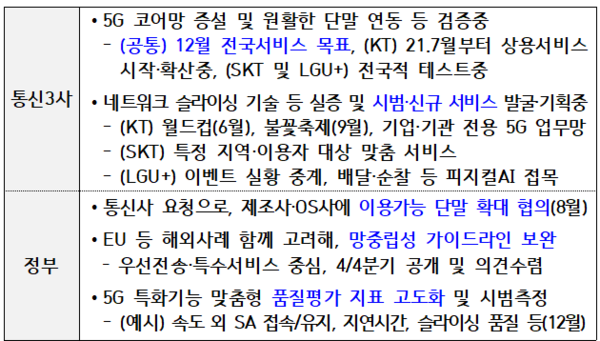
They also reviewed preparations for commercialising 5G SA planned for the end of this year. Carriers are expanding 5G core networks and conducting device interoperability verification. They are also pursuing demonstrations of network slicing technology that provides dedicated networks separated from public networks at sites where large crowds gather.
Network slicing is a core 5G SA technology that divides a single physical network into multiple virtual networks to provide an independent network for a specific service or area. The government and carriers agreed to identify 5G SA-based business-to-business (B2B) and business-to-consumer (B2C) services and expand on-site demonstrations, including priority transmission services for emergency rescue communications, ultra-low latency live broadcasts at crowded locations, and personalised services for users.
The ministry will also support the spread of 5G SA-enabled devices. It will also revamp net neutrality guidelines by reviewing cases in major countries so that services using new technologies such as network slicing can spread. It plans to overhaul the guidelines centred on standards for priority transmission such as emergency rescue communications and the application of specialised services, disclose a revision proposal in the fourth quarter this year and gather opinions.
It will also revamp the method for evaluating telecom quality. It plans to move away from an assessment focused on download speed and comprehensively reflect upload speed, transmission latency, network slicing quality and users' quality of experience (QoE).
The ministry plans to continue working-level consultations with the telecom industry and establish and announce a comprehensive plan within the year on next-generation network investment and regulatory improvement.
Choi Woo-hyuk (최우혁), director general for information security and network policy at the ministry, said, "The foundation of national competitiveness in the AI era is an intelligent communications network that supports it." He said the ministry will boldly remove regulatory and tax obstacles that hinder network investment and build a virtuous cycle structure for investment in next-generation communications networks.
 Jin-ho Lee
jhlee26@d-today.co.kr
Jin-ho Lee
jhlee26@d-today.co.kr