
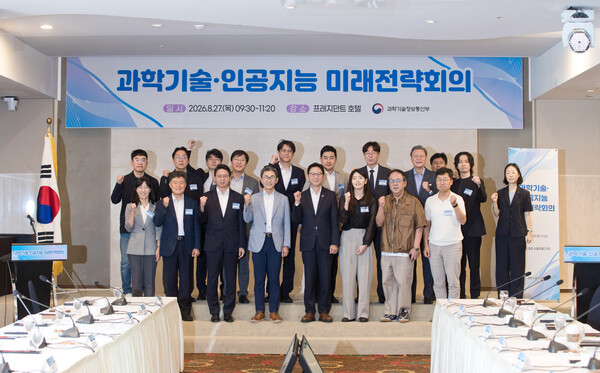
[Digital Today reporter Jin-ho Lee] "We must not create an irrational framework. The outcome of the great AI transition will be decided by institutions."
Choi Kyung-jin (최경진), a professor in the law department at Gachon University, said this at the second Science and Technology and AI Future Strategy Meeting held on Aug. 27. He said regulation is intended to address market shortcomings and reduce transaction costs, and that institutional design suited to the great AI transition is needed.
The Science and Technology and AI Future Strategy Meeting is a forum to identify key agenda items in preparation for advances in science, technology and AI and to discuss the direction of future policy. This meeting was held under the theme, "Opening of the AGI era." AGI refers to AI with general intelligence at or above human level across various fields.
Choi presented on costs and responsibility arising in the AI transition and on how to distribute benefits, under the theme "Designing laws and institutions in the token economy era." He said institutional preparations to raise predictability are urgently needed in step with the AGI era.
Choi voiced concern that as token costs rise, burdens could be concentrated on small and medium-sized enterprises, individuals and small-scale researchers. He said the more autonomy AI has, the more costs in the token economy could rise. "SMEs, individuals and researchers cannot help but worry about rising token costs," he said. "A legal basis is needed to provide computing resources for SMEs and R&D personnel," he suggested.
According to Choi, AI-related laws and institutions are required both to promote and accelerate innovation and to prevent and resolve problems in advance. He said the two directions must be balanced to raise South Korea's AI competitiveness. He argued that institutional foundations must be prepared at the same time to encourage technological advances and resolve disputes.
"The law itself must define its scope precisely. If reasonable criteria for judgment are vague, regulation also becomes unclear," he said. "The law must become a pre-designer that lays down the path for transition in advance."
He also said laws and institutions should not be too fast or too slow. "It is our role to continuously monitor and develop AI-related regulation so it is operated at a reasonable level," he stressed.
Shin Jin-woo (신진우), a professor at KAIST's Kim Jaechul Graduate School of AI, presented on measures to secure top-tier AI models. He stressed the need to expand computing infrastructure and increase investment in post-training for data. He proposed increasing use of domestically developed AI models starting in the public sector and building a virtuous cycle in which data accumulated through actual use is used again for model training.
"South Korea's data policy has supply but no accumulating cycle," Shin said. "We should increase investment in the post-training learning environment and focus on a cyclical structure that uses it again for learning."
Kim Hyun-chul (김현철), a professor at Yonsei University College of Medicine, presented on "AGI and society: Three markets that AI changes." He stressed the need to protect youth employment and reorganise medical and education systems in response to the spread of AGI. He suggested standardising medical data that is dispersed across hospitals so it can be used to develop medical AI.
After the presentations, private-sector committee members from each field, including industry, research and development, defence and broadcasting, discussed changes that AGI will bring and the government's response. They also exchanged views on restructuring labour, health care and education markets.
The meeting also drew attention for being conducted without job titles or ranks and using the honorific "nim" in addressing participants. Deputy Prime Minister Bae Kyung-hoon (배경훈), who is also minister of science and ICT, and meeting participants plan to create a group chat room to communicate frequently.
"Competition to secure top-tier AI models is intensifying, and the pace of AI development is also accelerating exponentially," Bae said. "It is time to think from now about how to prepare technologies, infrastructure and institutions needed in the AGI era."
He added that AGI is expected to have an enormous ripple effect, going beyond innovation in individual technologies and industries to reshape the overall national system and fundamentally change the way people live. He stressed that preparations must also be made for paradigm shifts across society, including changes in the economy and industry as well as labour, welfare and education.
 Jin-ho Lee
jhlee26@d-today.co.kr
Jin-ho Lee
jhlee26@d-today.co.kr