
The Bank of Korea raised its policy interest rate by 25 basis points to 3.00 percent from 2.75 percent. The decision came as the domestic economy is growing more strongly than expected on solid exports and a recovery in domestic demand, while inflation pressures persist and risks from financial imbalances such as Seoul-area home prices and household debt have increased.
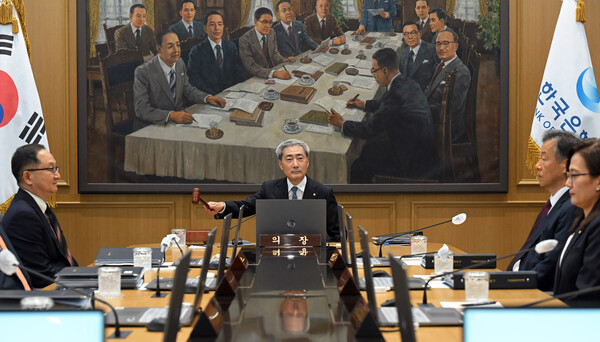
The central bank's Monetary Policy Board held a rate-setting meeting on Aug. 27 and decided to raise the policy rate to 3.00 percent from 2.75 percent.
The board said the domestic economy is maintaining stronger-than-expected growth supported by solid exports and a recovery in domestic demand. It forecast inflation will remain above the target level for a considerable period. It judged a rate hike was appropriate, given the need for a preemptive response to prevent inflation from broadening and to stay alert to financial stability risks.
It also raised its economic outlook sharply. The central bank forecast economic growth of 3.3 percent this year and 2.9 percent next year. That is up 0.7 percentage point and 0.8 percentage point, respectively, from its May projections of 2.6 percent for this year and 2.1 percent for next year. It said exports and investment would continue to post strong growth on a solid semiconductor cycle, while the recovery in consumption would broaden as income conditions improve.
Inflation pressure was also cited as a key backdrop to the rate hike. The July consumer inflation rate eased to 2.8 percent from the previous month, but core inflation excluding food and energy rose to 2.6 percent.
The central bank forecast consumer inflation of 2.7 percent this year and 2.3 percent next year. It projected core inflation at 2.5 percent for both this year and next year, raising the prior forecasts of 2.4 percent and 2.3 percent. It said inflation is expected to remain above the target level for a considerable period as accumulated cost pressures pass through and demand-side inflation pressures rise with the recovery in domestic demand.
Real estate and household lending also served as caution factors for the board. The central bank assessed that Seoul-area home prices have continued to rise at a high pace and household loans have increased by a considerable amount. In July, Seoul home transaction prices rose 1.1 percent from the previous month and the Seoul metropolitan area rose 0.7 percent. Bank household loans increased by 5.4 trillion won in July, including a 3.4 trillion won rise in mortgage loans.
The central bank also left open the possibility of further rate hikes. The board said it will decide the timing and pace of additional increases while monitoring inflation and growth trends and financial stability conditions such as Seoul-area home prices and household debt.
A conditional outlook for the policy rate six months ahead by board members also showed additional hikes were more likely. Of a total 21 rate projections presented by members, 3.50 percent accounted for 6, 3.25 percent for 10, and the current level of 3.00 percent for 5. That means 16 of the 21 points indicated a higher level than at present.
Six board members supported the decision to raise rates. Member Geon-il Hwang (황건일) issued a dissenting opinion, saying it would be desirable to keep the policy rate at 2.75 percent.
 Ji-young Lee
ljy@d-today.co.kr
Ji-young Lee
ljy@d-today.co.kr