
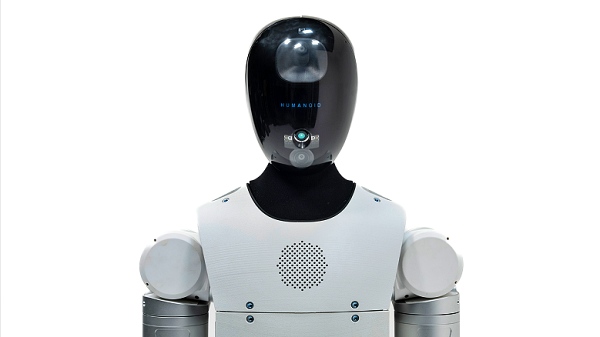
[DigitalToday reporter Jinju Hong (홍진주)] Expectations for growth in the humanoid robot market are rising, but the range of robotics companies and exchange-traded funds (ETFs) that can be seen as real investment targets has yet to be clearly defined. Even ETFs promoted under the same humanoid theme can differ widely in holdings and investment direction. That makes it necessary to examine what robot industry investors are actually investing in.
On Aug. 25 (local time), blockchain media outlet Cryptopolitan reported that BofA Global Research said in its report, "Physical AI, part 2: Humanoid robots," that annual humanoid robot shipments could rise from about 20,000 units now to 10 million units by 2035.
But the growth outlook for the humanoid market does not translate into the same investment opportunity for all robotics companies. Firms that directly produce robots, parts and semiconductor suppliers, industrial automation equipment makers and robot software companies are lumped together as "robotics stocks," even though their business structures differ widely.
Among listed companies, UBTech Robotics, listed in Hong Kong, is cited as the company most directly exposed to humanoid robots. It sells Walker-series humanoid robots as well as education and service robots. In fiscal 2025, revenue from full-size humanoid robots was 820.6 million yuan, accounting for 41.1% of total revenue, and unit sales were 1,079.
But judged by performance alone, risks typical of growth stocks remain large. UBTech Robotics posted a net loss of 789.8 million yuan and an operating cash outflow of 784.1 million yuan over the same period. That means it is hard to say rising humanoid revenue has yet led to stable profitability.
China's Unitree Robotics is also classified as a company with a high share of robot business. In 2025 revenue, humanoid robots accounted for 51.78% and quadruped robots for 41.62%. But it is in the process of listing on Shanghai's STAR Market, and as of Aug. 10, trading in the secondary market had not yet been confirmed. Limited accessibility for U.S. investors is also a variable.
In U.S. markets, Symbotic, Serve Robotics and Richtech Robotics are cited as pure-play robotics companies. Symbotic is a leading example that has already secured a commercial market in warehouse automation. As of June 27, it had about $22.5 billion in order backlog, but 90.5% of fiscal 2026 third-quarter revenue came from a single customer. That implies both the advantage of fast growth based on a major customer and the risk of heavy dependence on one customer.
Serve Robotics operates sidewalk delivery robots. Revenue in the second quarter of 2026 was $3.24 million, and it posted a net loss of $64.13 million. Its network currently has more than 2,000 sidewalk delivery robots and more than 100 Moochi robots deployed in 44 cities.
Richtech Robotics supplies robots to the service sector, including restaurants and hotels. Revenue in fiscal 2026 second quarter was $1.5 million, but it does not disclose separate revenue for its humanoid business because it is still at an early stage.
If the scope of robotics investing is broadened, it also includes companies such as Nvidia that supply semiconductors and simulation tools needed for robot development. Nvidia does not disclose robot business as a separate revenue item, but total revenue in fiscal 2027 first quarter was $81.62 billion. Of that, revenue in its edge computing segment, which includes robot-related business, was $6.37 billion.
Nvidia can therefore be seen as a beneficiary of growth in the robot industry, but its investment characteristics differ from those of pure robotics companies that sell robots themselves.
Teradyne is also cited as a company that offers indirect exposure to the robot industry. Through collaborative robots at its subsidiary Universal Robots and autonomous mobile robots at Mobile Industrial Robots, it posted fiscal 2025 robot revenue of $308.3 million. That is about 10% of total revenue of $3.19 billion.
Harmonic Drive Systems and Leader Harmonious Drive Systems, which supply precision reducers and drive components, are also cited as companies worth watching. The logic is that if humanoid robot production expands to multiple manufacturers, investors can benefit from rising demand for core components even without picking the winning robot maker.
If the scope is extended to ETFs, differences in investment approach become clearer. KraneShares' KOID is heavily oriented toward diversified investment across the physical AI supply chain, including sensors and computing, measurement equipment and auto parts.
By contrast, Roundhill's HUMN is shown to have high weightings in UBTech Robotics, Tesla, Harmonic Drive, Leader Harmonious Drive and Hyundai Motor. Both ETFs were launched in June 2025 about three weeks apart, but their top holdings differed substantially. In the end, if KOID is closer to a "physical AI basket" that invests in the broader robot-industry supply chain, HUMN is closer to a structure that invests in stocks more directly tied to humanoid development and hardware.
Investment risks are also significant. The biggest variable is whether humanoid robots can prove real commercial utility and economic viability beyond demonstrations. Shipment forecasts do not automatically mean large-scale orders for manufacturers. If the pace of real-world deployment is slower than expected or cost-effectiveness is not sufficiently proven, current growth expectations could weaken.
Policy variables related to China also remain. Chinese companies are rapidly expanding robot automation, but import restrictions and tariffs could affect the pace of industry growth.
Ultimately, in robotics investing it is becoming more important to confirm how investors are exposed to the robot industry rather than simply looking at the label "robot stocks." UBTech Robotics, which directly produces humanoid robots, Nvidia and Teradyne, which supply components and semiconductors, warehouse automation company Symbotic, delivery-robot company Serve Robotics, and humanoid ETFs can all be grouped under the robotics theme, but their profit structures and risk factors differ.
In particular, the article says investors should not buy humanoid ETFs based only on their names, but should check actual holdings and weightings, as well as fees. Even if the humanoid market enters a full-fledged growth phase, it has yet to be decided which companies and ETFs will actually benefit.
 Jinju Hong
hongjj@d-today.co.kr
Jinju Hong
hongjj@d-today.co.kr