
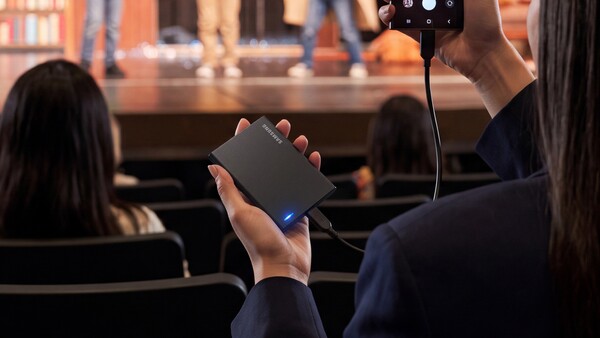
Samsung Electronics unveiled two new portable solid-state drive (SSD) models featuring the next-generation USB4 interface. Samsung said it introduced the two models, the P9 and P7, at the Gamescom 2026 game show in Cologne, Germany, on Aug. 26 local time.
The flagship P9, based on USB4, supports transfer speeds of up to 4,000MB per second for sequential reads and 3,800MB per second for sequential writes. Sequential read and write speeds are about twice those of the previous generation T9 and T7 products. The everyday-use P7 is also based on USB4 technology and is compatible with a range of devices including desktops, laptops, smartphones, game consoles and cameras.
The previous-generation T9 used USB3.2 Gen 2x2, with sequential read and write speeds each around 2,000MB per second. The P9 doubles that speed by switching the interface to USB4. Samsung said it was the first in the world to introduce a USB4 product that delivers 4,000MB/s even at 8TB capacity, and that it won the CES 2026 Innovation Award in recognition of that technology.
Based on its sequential write performance, the P9 supports 12K direct recording, storing 12K video in real time. It is aimed for use at professional shooting sites because it can store and edit large RAW photos and high-resolution video without interruption. The P7 has passed a 2-metre drop shock test and vibration durability verification, allowing it to protect data even in environments with frequent movement.
Kwon Hyung-seok (권형석), an executive vice president in Samsung Electronics' Memory Business brand product business team, said, "As AI-based content creation and the use of large data such as ultra-high-resolution video become part of daily life, users expect a faster and more stable storage experience." He said, "The portable SSD P series will support fast file storage and backup, providing the best work environment for professionals as well as a variety of everyday users." Samsung's portable SSD P series will be released sequentially from September in global markets including South Korea in four capacities: 1TB, 2TB, 4TB and 8TB.
 Suk Dae-gun
d2dg@d-today.co.kr
Suk Dae-gun
d2dg@d-today.co.kr