
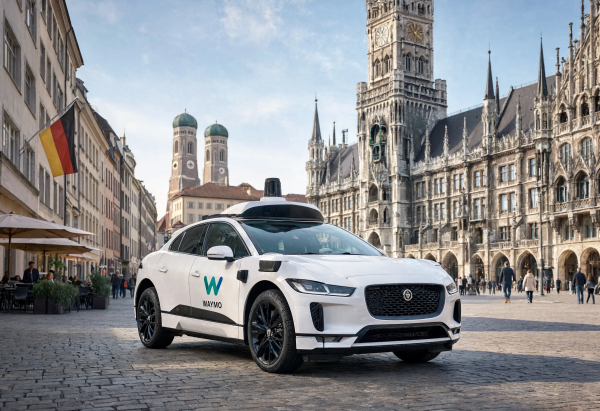
Waymo is pushing to launch a robotaxi service in Munich, Germany.
On Aug. 25, foreign media including tech outlet TechCrunch reported that Waymo formalised its plan for a commercial service in Munich a few months after setting up a German unit. It would be the third overseas expansion by Waymo, Alphabet’s self-driving unit, and its first entry into the European Union.
The service will not start immediately. Waymo plans to first map Munich roads with vehicles driven by people, then conduct autonomous driving tests with safety operators in the driver’s seat. It will then move to driverless tests without safety operators. In this process, Waymo employees, the media and invited guests typically ride in the vehicles. The tests will focus on building high-definition road maps, training autonomous driving specialists and adjusting software to Munich’s driving environment.
Waymo co-CEO Tekedra Mawakana (테케드라 마와카나) said in a blog post, "Munich is a global hub of mobility and engineering, and becoming part of this city is an important milestone in our global expansion."
Waymo plans to start with a limited service and then expand to the general public after receiving regulatory approval needed for commercial operations. The company said it is working with Germany’s Federal Motor Transport Authority, state governments and local authorities, and expected to start a commercial ride-hailing service for the public around late 2027. Munich is Germany’s third-largest city, and Waymo said it is working with local, state and federal authorities to secure the necessary permits and approvals there.
The move draws attention because Germany is a market that first established autonomous driving legislation in Europe. Germany introduced a law more than 5 years ago allowing driverless vehicles on public roads, creating the EU’s first legal framework for Level 4 autonomous driving. Level 4, as defined by SAE International, means the system handles all driving without human intervention under certain conditions or environments.
On the back of that system, Germany has become a hub for autonomous driving tests. The latest data from the Federal Motor Transport Authority shows several companies, including Mobileye and Volkswagen, currently hold test permits. Waymo has yet to secure a local test permit.
Germany’s permit structure also highlights Waymo’s challenge. Most companies currently authorised, including British autonomous driving startup Wayve and Israeli firm Autobrains, remain at Level 3 standards. Level 3 is conditional automation in which the system drives under specific operating conditions such as low-speed highway driving, but the driver must be able to intervene immediately when needed. The robotaxis Waymo is targeting assume a higher level of autonomous driving.
Waymo’s Munich plan is an extension of its strategy to expand in Europe. Waymo currently operates commercial robotaxis in 11 U.S. cities and is pushing to expand to 19 more cities, according to its website. Last month it announced expansions to San Diego, Las Vegas, Tampa, Florida, and Denver.
In overseas markets, Munich is its third expansion city after London and Tokyo. Waymo has already said it will start a service for the general public in London as early as next month, where it will face a partnership between Wayve and Uber. China’s Baidu has also begun autonomous vehicle tests in London based on partnerships with Lyft and FreeNow.
Waymo’s European expansion does not stop at Germany. The company set up units in France, Spain and the Netherlands around the time it established its German unit in June, and registered a unit in Switzerland this month, industry outlet Zag Daily reported.
Waymo also said as of March its cumulative fully autonomous driving distance reached about 221 million miles, or about 356 million km.
In this context, Munich is expected to become another test case for Waymo’s push into Europe. Waymo said it will apply the same procedures in Munich as it did for commercial robotaxi operations in 11 other cities, and plans to expand step by step from a limited service to a public service after consultations with German regulators. Ultimately, securing local test permits and the pace of regulatory approvals are expected to be key.
 Seung-ah Yoo
ysah@d-today.co.kr
Seung-ah Yoo
ysah@d-today.co.kr