
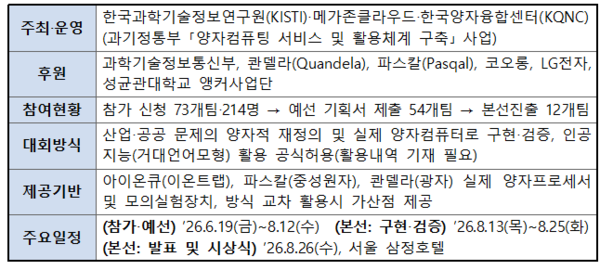
South Korea's Ministry of Science and ICT will hold the finals of the Quantum Reframing Challenge 2026 on Tuesday at the Samjung Hotel in Seoul.
The contest is designed to redefine problems from industrial and public-sector sites into forms suitable for quantum computers and to verify their solvability using real quantum computers. The government on Aug. 12 selected the quantum field as a next-generation frontier area under its seven future growth-engine “SEED” sectors. Another aim is to expand use of IonQ's 100-qubit ion-trap quantum computer being built at the Korea Institute of Science and Technology Information (KISTI).
Preliminary rounds that began on June 19 drew applications from 73 teams, totaling 214 people. Of those, 54 teams submitted proposals on industrial and public-sector problems in areas such as manufacturing, materials, finance, optimisation and AI. After evaluation, 12 teams advanced to the finals.
Final-round tasks are broadly divided into computational science and combinatorial optimisation. The computational science track seeks to complement the calculation limits of classical computers with quantum computers. Tasks include calculating nitrogen-molecule bond-breaking energy for ammonia-synthesis catalysts, correcting calculations of precursors for semiconductor deposition and etching, and predicting decomposition pathways of battery electrolyte additives.
The combinatorial optimisation track converts problems with too many possibilities for classical computers to find optimal solutions into forms suited to quantum computers. Representative examples include assigning tasks for port yard cranes, controlling the direction of low-frequency noise at outdoor concert venues, and accelerating searches in the process of identifying victims of major disasters.
Finalists implemented and validated their tasks from Aug. 13 to 25 in three different real-world quantum computing environments: ion-trap (IonQ), neutral atom (Pasqal) and photonic (Quandela). The finals will focus on evaluating comparative analyses versus classical computing, industrial applicability and technical limitations.
The top five teams will receive a total of 20 million won in prize money. One grand prize team will receive an award from the deputy prime minister and science minister and 7 million won. Two teams will receive the KISTI president's award and 4 million won each, and two teams will receive the Korea Quantum Convergence Center director's award and 2.5 million won each.
Sponsors including Quandela, Pasqal and Kolon will also present special awards. Winning teams will be offered collaboration opportunities including quantum computer usage time, internships, visits to Quandela's headquarters in France and follow-up support after proof of concept.
Kim Sung-soo (김성수), director general for research and development policy at the ministry, said quantum computers are a core strategic technology that can open a new future by surpassing the limits of classical computers. He said the government would strengthen support not only for quantum computer hardware but also for industrial use to speed implementation of the quantum sector under the seven SEED areas.
 Jin-ho Lee
jhlee26@d-today.co.kr
Jin-ho Lee
jhlee26@d-today.co.kr