
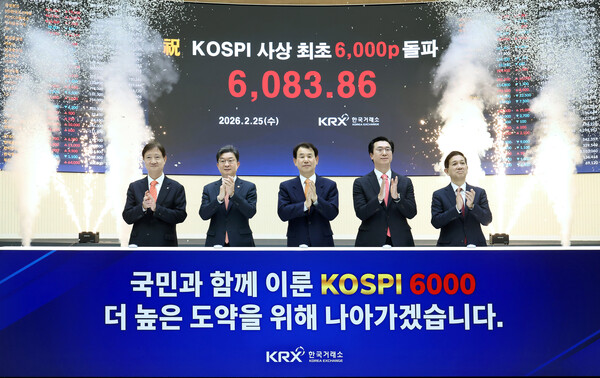
[Digital Today reporter Sang-yeop Oh] South Korea's KOSPI on Feb. 26 broke above 6,300 on a closing basis, extending a run of record highs a day after it first closed above 6,000. Market capitalisation also topped 5 quadrillion won.
The Korea Exchange said the KOSPI, after closing above 6,000 for the first time a day earlier, opened higher at 6,121.03 and set an intraday high of 6,313.27 as it extended a record rally.
Samsung Electronics, the index heavyweight, ended up 7.25 percent at 218,250 won. SK Hynix also surged 7.76 percent to close at 1,097,000 won. Both extended record highs and strongly drove the index higher.
The KOSPI first broke above 3,000 on Jan. 7, 2021. It topped 4,000 on Oct. 27, 2025, settled above 5,000 on Jan. 27, 2026, and crossed 6,000 on Feb. 25.
While it took nearly 4 years to rise from 3,000 to 4,000, it took only a few months to move from 4,000 through 6,000 to 6,300, showing a clear acceleration in gains.
The KOSPI returned 75.6 percent last year, ranking first by a wide margin among major Group of 20 stock markets, and has continued to rise more than 40 percent so far in 2026. Discussion is also gaining pace over increasing global funds' exposure to South Korean stocks.
Index lifted by semiconductors, autos and brokers
The first driver of the KOSPI's surge is a super-boom in memory semiconductors driven by an artificial intelligence boom. Samsung Electronics and SK Hynix have seen earnings expectations rise on increasing demand for HBM for AI servers and next-generation DRAM, accounting for more than half of the increase in KOSPI market capitalisation since the presidential election.
When the KOSPI first broke above 4,900 on Jan. 19, a rally in large-cap auto stocks led by Hyundai Motor and Kia lifted the index. Hyundai Motor rose more than 15 percent on the day, ranking third by market value.
When the KOSPI crossed 5,300 on Feb. 4, Samsung Electronics became the first domestic company to top 1 quadrillion won in market value, raising the index ceiling. Other top market-cap stocks including Hyundai Motor, LG Energy Solution and Hanwha Aerospace also rose together.
On Feb. 19, the first trading day after the Lunar New Year holiday, the KOSPI early in the session first rose above 5,600. Brokerage shares, helped by expectations of treasury share cancellations, hit daily price limits in a run that lifted both turnover and the index.
Many brokerage shares, including Mirae Asset Securities, SK Securities, SangSangIn Securities and Hyundai Motor Securities, also set fresh 52-week highs and stood out as "value-up beneficiaries".
Policy effects from value-up, commercial law revisions and tax changes
A key difference between this rally and past semiconductor upcycles is that capital market reform policies targeting the so-called "Korea discount" have been pursued in parallel.
The Lee Jae-myung government pushed legislation in the direction of strengthening minority shareholder rights by pursuing amendments to the Commercial Act three times. It also sought to institutionalise mandatory treasury share cancellations and limits on using treasury shares to defend management control.
Through the corporate value-up programme introduced in 2024, the government required companies to disclose "corporate value enhancement plans" and set out dividends, capital efficiency and treasury share policies in detail. It granted tax incentives to companies that faithfully implement them.
Separate taxation of dividend income, implemented in earnest from 2026, raised the investment appeal of high-dividend stocks and financial and holding companies, prompting higher payout ratios and expanded treasury share cancellations. That also led to high returns for related ETFs.
A tough stance on stock price manipulation, along with revisions to delisting and disclosure rules and efforts to improve trading transparency, is also assessed as easing factors for the Korea discount.
An assessment also says policy trust increased because the government presented the stock market as a core pillar of "productive finance" and maintained a stance of steering funds concentrated in real estate toward capital markets.
Easing of the Korea discount and a shift in capital market status
KOSPI 6,000 is interpreted as a signal that the Korea discount, often summed up by low price-to-book ratios, low payout ratios and opaque governance among South Korean listed firms, is being eased to some extent.
As companies raise capital efficiency through treasury share cancellations, bigger dividends and the sale of non-core assets, a broader trend is spreading in which valuations are reassessed even for value stocks, financial stocks and holding companies.
Rising stock prices are also changing the structure of household financial assets.
As South Korean stocks repeatedly post top-tier global returns, preferences are growing for long-term investment through stocks and ETFs. Expectations are emerging that if funds once concentrated in real estate become more diversified, it could also work positively for stabilising the real estate market.
For companies, higher stock prices and a bigger market capitalisation improve conditions for raising capital through rights offerings and corporate bond issuance, expanding room for investment.
The market is split between views that the KOSPI is showing short-term overheating signals and expectations of further upside if profit growth continues. An analysis says further rerating is possible, centred on Samsung Electronics and SK Hynix, if the semiconductor cycle recovers more steeply than expected and investment in AI servers and demand for HBM4 and next-generation DRAM continue.
Substantive implementation of value-up policy and maintaining consistency in tax and Commercial Act revisions are also cited as important conditions.
If companies execute their disclosed value enhancement plans and the government can run rules on short selling, disclosure and governance separately from political variables, an outlook says South Korean stocks could attempt a stable upward trend after 6,000 on the back of an "earnings market".
Concerns about overheating and domestic and external variables, with risk management also needed
Several indicators also show signs of overheating.
The KOSPI broke above 6,000 less than a month after settling above 5,000, with the move amounting to a time correction rather than a price correction. Price-to-earnings ratios and price-to-book ratios for top market-cap stocks have risen to levels above past averages. The fast rise is a short-term risk factor in that it can increase volatility even on minor bad news.
Rising short selling and stock lending balances are also cited as a burden.
Stock lending balances betting on a decline in South Korean shares are around 150 trillion won, and net short positions exceed 20 trillion won, both setting record highs. The fear index has also been rising as the KOSPI approaches 6,000. This means many market participants have a short-term correction in mind.
Externally, uncertainty over U.S. trade and monetary policy and the possibility of a slowdown in results for global AI and technology stocks are variables.
If a correction emerges after results announcements for key U.S. AI names such as Nvidia, it could also affect South Korean semiconductor and IT stocks. Changes in the pace of U.S. Federal Reserve rate cuts directly affect the won-dollar exchange rate and foreign investor flows.
Domestic factors such as delays in cleaning up troubled real estate project financing, restructuring of marginal companies and the burden of household debt are cited as potential risks.
There are also concerns that if value-up policy is used only as a short-term tool to prop up the index, or retreats depending on the administration and political situation, investor trust could be damaged and a "policy premium" could turn back into a "policy risk".
Experts point out that after KOSPI 6,000, policy should focus on stable gains and improving market fundamentals rather than short-term stimulus.
A financial investment industry official said, "Checking the implementation of corporate value-up plans, establishing profit-based dividend and treasury share policies, strengthening minority shareholder rights, improving the short-selling system and establishing fair market order will determine the direction." The official added, "Policies to ease real-economy risks should also be pursued in parallel, including restructuring tax and pension systems to encourage households' long-term and diversified investment, financial stability measures to address fund shifts between real estate and stocks, and management of real estate PF and vulnerable borrowers."
Another view says whether KOSPI 6,000 becomes a starting point for improving the structure of South Korea's capital market, rather than a temporary peak, depends on whether those policy tasks are implemented.
 Sang-yeop Oh
yub@d-today.co.kr
Sang-yeop Oh
yub@d-today.co.kr