
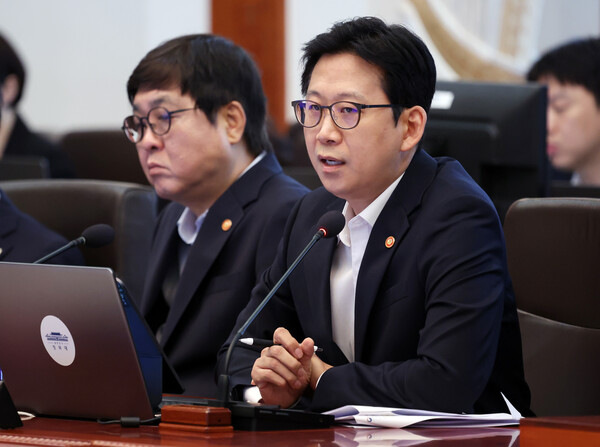
The government will challenge world-leading open models in the second half of this year based on an upgrade of its own AI model. It will also pursue development of a top-tier frontier AI model in 2017. The public service "Everyone's AI" will start a beta service next month. Deputy Prime Minister and Minister of Science and ICT Bae Kyung-hoon (배경훈) introduced the results of developing an indigenous AI foundation model and the future direction at a cabinet meeting chaired by President Lee Jae-myung (이재명) on Monday.
Bae mentioned that the United States and China have blocked, or are reviewing blocking, overseas access to their top-tier AI models. He viewed securing an indigenous AI model as a task linked to national security. "AI models are now national security itself," he said. "Making an indigenous model is about having on this land an ecosystem where talent that can handle technology can grow."
Bae also mentioned that AI startup Anthropic is being recognized for its high corporate value. "Those who have AI are reshaping the global economic landscape," he said. "Securing the capability to develop an indigenous AI model is a question of whether the country can stand on its own."
The Ministry of Science and ICT will expand use in the public, industrial and government sectors, along with upgrading the indigenous AI foundation model that is currently under way.
The Dokpamo project enters its third phase. The performance of domestic models currently falls somewhat short of China's major open AI models, but the goal is to improve performance in the second half of this year to catch up with world-leading open models. "Next year, we will challenge development of a top-tier frontier model by投入ing more GPUs and data," Bae said.
The public AI service "Everyone's AI" will provide a beta service starting in September and a full service in December. In 2027, it will push to implement "one person, one agent," in which each citizen uses an AI agent.
In security, it will first develop security-specialised AI in the second half of this year and use it for vulnerability detection and other purposes. Next year, it will upgrade it into an AI-based security system through additional development and data investment. The government administrative network will use the indigenous AI model as the basic AI model to improve work efficiency and support qualitative improvement of public services for the public.
"We will continue to advance AI models so that South Korea can make a leap to become an AI powerhouse in name and reality," Bae said.
 Jin-ho Lee
jhlee26@d-today.co.kr
Jin-ho Lee
jhlee26@d-today.co.kr