
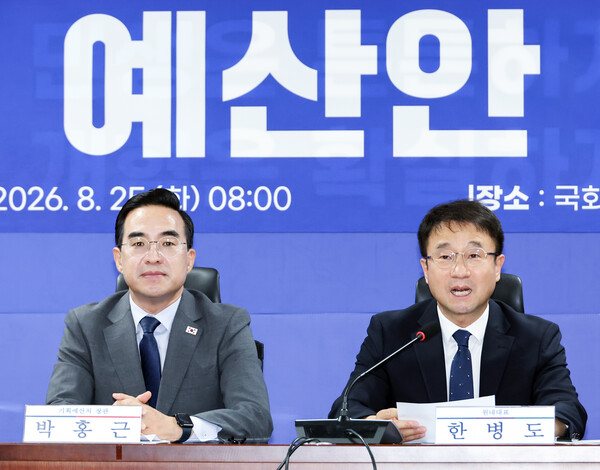
The government and the ruling party held budget talks on next year's spending plan and stressed their commitment to investment in three mega projects and AI.
The government and the Democratic Party on Aug. 25 held ruling party-government talks on the 2027 budget bill at the National Assembly. They selected five priority investment areas: AI and three mega projects; expanding future growth engines such as space and bio; step-by-step support for youth growth; responding to K-shaped polarization and promoting locally led growth; and strengthening public safety.
In AI and semiconductors, they will set up a special semiconductor account to provide integrated support for related programmes. They will also support the development of AI solutions using so-called manufacturing tacit knowledge accumulated at production sites, to strengthen competitiveness in physical AI.
They will also expand support for computing infrastructure to develop frontier-level AI models. The government plans to back domestic AI model development by supplying 10,000 GPUs. It will also reflect in the budget bill support to secure power and water needed for the semiconductor industry.
They will increase investment in so-called future growth engines such as space and bio. They will support research and development for a 2030 lunar landing and expand pilot areas for autonomous vehicles. They also plan to expand electric vehicle purchase subsidies to the highest level ever.
The ruling party and the government will also create a future-response fund to use higher tax revenue from a semiconductor boom for investment in future growth. The government plans to use it as a strategic investment platform to lift potential growth and as a fiscal stabilization tool to ease tax-revenue volatility.
In youth support, they will introduce a university student internship semester system that grants academic credit when students work as interns for one semester. They will create a "Our Child Self-Reliance Fund" that provides up to 1.2 million won a year until age 18, and also push a plan to expand and revamp the existing child allowance into a basic child allowance.
To support regional growth, they will create a growth engine special subsidy. It would have the government support a significant portion of facility investment when an anchor company relocates to a region. They will also create a regional future growth support fund and push a special account for essential local medical care and full tuition support for local national universities.
The public safety area includes support for developing a nuclear-powered submarine and raising pay for junior military officers.
Park Hong-geun (박홍근), minister of the Office of Planning and Budget, said the 2027 budget bill is the first budget for which the government fully oversaw the entire process before budget drafting. He said the focus was on supporting a major leap for an "irreplaceable Korea" through active fiscal management.
Han Byung-do (한병도), floor leader of the Democratic Party, said priorities must be set on where and how much to invest first as fiscal capacity has increased. He said a solution is needed to strategically deploy resources to various fiscal demands, including youth, locally led growth and future strategies.
 Jin-ho Lee
jhlee26@d-today.co.kr
Jin-ho Lee
jhlee26@d-today.co.kr