
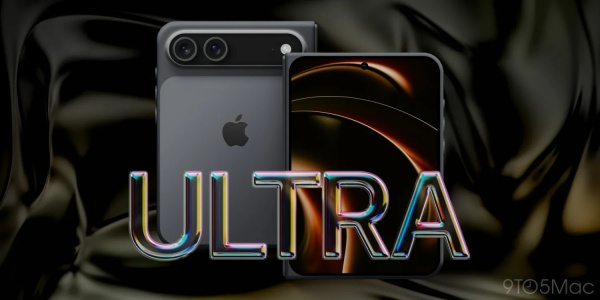
As the possibility grows that Apple's first foldable iPhone could be unveiled in September, an outlook has emerged that its core specifications could be reduced compared with existing flagship models.
According to the IT outlet 9to5Mac on Aug. 24 (local time), the device is speculated to launch under the name "iPhone Ultra" at a price above $2,000 (about 2.768 million won). It is expected to face several constraints in the camera, biometric authentication, charging and SIM structure.
The biggest change is expected to be the camera setup. The device is projected to include only two rear cameras, a main camera and an ultra-wide camera, and to exclude a telephoto camera. Both cameras are 48 megapixels, and a level similar to the base iPhone 17 model is being mentioned.
The button layout is also expected to change significantly. Leaked iPhone Ultra mockups show neither an action button nor a mute switch, raising the possibility it could be the first iPhone to include neither feature. The left side is expected to be left without buttons, with the side button and camera control button placed on the right. The volume buttons may be moved to the top of the device like the iPad mini.
Touch ID is seen as the leading option instead of Face ID. The approach is to embed Touch ID in the side button. If implemented, it would be the first iPhone without Face ID since the iPhone X in 2017. It appears to reflect limitations in internal space due to an ultra-thin foldable structure and the burden of having to place Face ID components on both the outer and inner displays.
In charging, it is unclear whether MagSafe will be supported. As a MagSafe ring was not seen on the back of leaked dummy devices, it is speculated that only standard wireless charging will be supported.
For connectivity, a global eSIM-only approach is seen as likely. Multiple sources including Ming-Chi Kuo and Bloomberg have projected that the physical SIM slot will be removed, and an ultra-thin design is being cited as a key reason. The iPhone Air, which highlights a thin design, was also launched as eSIM-only worldwide. By contrast, the iPhone 17 and iPhone 17 Pro are sold as eSIM-only only in some countries such as the United States, while other markets, including China, keep a physical SIM slot.
Ultimately, Apple is likely to apply a new folding design to its first foldable iPhone while excluding some familiar features. The completeness of the foldable iPhone depends less on the form itself than on how much usability offsets the missing functions.
 Yoonseo Lee
yslee@d-today.co.kr
Yoonseo Lee
yslee@d-today.co.kr