
Concerns have been raised that the government’s planned second phase of digital asset legislation could stifle innovation in the domestic industry and weaken global competitiveness through excessive regulation.
In particular, critics described proposed limits on major shareholders’ stakes in digital asset exchanges and a requirement that banks hold 51 percent equity when issuing stablecoins as “unprecedented regulation,” and said building a structure of trust should take priority over control.
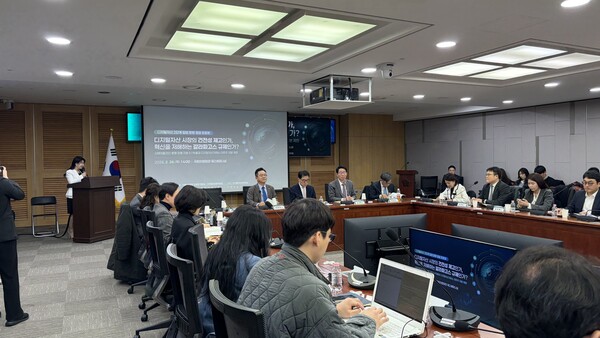
On Feb. 26, the offices of People Power Party lawmaker Kim Sang-hoon (김상훈) and Democratic Party lawmaker Min Byung-duk (민병덕) held a forum at the National Assembly Members’ Office Building’s Second Seminar Room under the theme, “Improving the soundness of the digital asset market, or Galapagos regulation that hinders innovation?”
Kim strongly criticised a recently discussed 15 to 20 percent cap on major shareholders’ stakes in digital asset exchanges.
Kim said restricting major shareholders’ stakes after the fact was unprecedented even in global markets, and called it a very risky idea that could sharply undermine trust in South Korea’s digital asset market.
He added that the moment called for policy and legislation that would give the digital asset market wings.
Min also warned against a closed system.
Min said stablecoins were not just digital assets but payment and settlement infrastructure for the digital era and a market for first-mover competition. He said a 51 percent bank stake rule did not guarantee safety, and that excluding private-sector technology and platform capabilities would result not in stability but stagnation.
He also said that just as automobiles cannot be operated with rules from the horse-drawn carriage era, the country should build a structure of trust rather than a framework of control.
At the event, figures from academia, the legal profession and industry took part as presenters and examined related legal and economic issues.
Attorney Jeong Jae-wook (정재욱) of Law Firm Juwon explained, under the theme “Limits on major shareholders’ stakes in digital asset exchanges from the perspective of national competitiveness,” that stock exchanges have a highly public-interest character under the Capital Markets Act, but digital asset exchanges are difficult to view as operators with a public-interest character, and neither is a de facto monopoly institutionally enforced.
He added that forcing existing private companies to sell down major shareholder stakes could raise concerns about infringement of private property rights and could signal that would hinder private-sector efforts at challenging innovation in new business areas.
Professor Lee Jong-seop (이종섭) of Seoul National University’s business school directly criticised the authorities’ current regulatory direction under the theme “The 51 percent bank stake rule for stablecoin issuance from an innovation perspective.”
Lee said concentrating ownership structure around banks did not fundamentally block risks such as bank runs. He argued for a paradigm shift away from institution-centred governance regulation to “trust infrastructure regulation.”
He presented five technology-based regulatory designs as specific alternatives, including real-time disclosure of reserve transparency, rules on asset composition and automatic redemption smart contracts.
On another issue, “the unconstitutionality of limits on major shareholders’ stakes in digital asset exchanges,” Professor Choi Seung-jae (최승재) of Sejong University’s law department said digital asset exchanges were companies that grew on private-sector creativity and technological innovation, and attempts to strip management rights, a core of private property, on the grounds of public interest were highly likely to violate Article 23 of the Constitution, which guarantees property rights, and Article 37, which sets the principle against excessive restrictions.
Choi said banks’ system-risk transmission and exchanges’ situations were fundamentally different. Citing a minority opinion in a 2007 Constitutional Court precedent, he argued that less intrusive alternatives, such as ex post supervision, should be sought rather than “pre-emptive deprivation of equity.”
Professor Ryu Kyung-eun (류경은) of Korea University’s law school said regulation of stablecoin issuers should focus not on who they are but on the “capacity” to fulfil specified obligations. She suggested prioritising major shareholder fitness reviews and stronger internal controls rather than the last-resort measure of limiting exchange stakes.
Attorney Hyun Ji-hye (현지혜) of Law Firm Changcheon warned of side effects from stake ceilings, saying artificially dispersing ownership weakens incentives for responsible management by major shareholders who are accountable for long-term corporate value and drives focus toward short-term gains, which could instead create gaps in user protection.
Cho Young-gi (조영기), secretary general of the Korea Internet Corporations Association, also said that uniformly limiting major shareholder stakes reduces investor predictability, could dampen investment sentiment across the startup ecosystem, and could ultimately weaken global competitiveness by prompting domestic companies to move overseas.
 Oh Sang-yup
yub@d-today.co.kr
Oh Sang-yup
yub@d-today.co.kr