
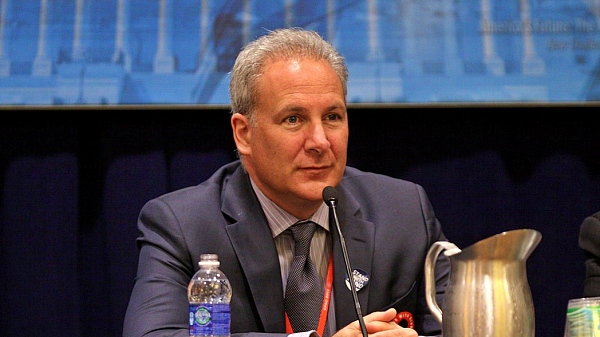
Economist Peter Schiff (피터 시프) directly rebutted the view that the spread of artificial intelligence (AI) will act as a positive factor for Bitcoin.
On Aug. 23 (local time), blockchain outlet U.Today reported that Schiff said Bitcoin supporters are trying to hitch Bitcoin to the AI investment boom, but argued AI could instead become a threat to Bitcoin.
Schiff’s first reason was competition for investment funds. As AI emerges as a core investment theme in financial markets, speculative money could tilt more toward AI-related assets than Bitcoin, he said.
He also pointed to competition over power and data centre infrastructure. Since both the Bitcoin network and the AI industry require large-scale electricity and computing resources, clashes over resource allocation could occur, he said.
He also cited security issues as a key point. If AI performance becomes more advanced, it could find vulnerabilities in Bitcoin software or cryptographic structures that humans have not yet discovered, he said.
Schiff said Bitcoin’s security and limited supply structure are based on the premise that related software and cryptographic systems continue to function as intended. He said there is no evidence that AI has actually discovered vulnerabilities in Bitcoin, but argued AI could shake that basic premise in the future.
On the same day, Schiff again brought up his existing criticism of Bitcoin. In response to a post mentioning Bitcoin’s past gains, he replied, "AI is not a scam but Bitcoin is a scam," and repeated his claim that buying precious metals instead of Bitcoin would have been better. He also argued that over roughly the past 5 years it would have been better not to hold Bitcoin, and that long-term holders ended up making money because they did not sell.
He also expressed a negative view of the recent rebound in Bitcoin’s price. Schiff described the move as "not a breakout but a deception" and urged selling Bitcoin and buying gold. The remarks were seen as again stressing his existing skepticism not only about investment narratives linking AI and Bitcoin but also about Bitcoin’s price moves and role.
Schiff’s claims, however, are not based on any currently confirmed technical flaws or actual security incidents. A key question is what investment logic the market will apply to the relationship between AI and Bitcoin, and what counterarguments Bitcoin supporters will offer.
Ultimately, the core of the debate is whether AI will become a complementary good that expands demand for Bitcoin or a substitute that competes over investment funds and infrastructure. The actual impact is expected to be gauged through future flows of AI-related funds and changes in costs in the Bitcoin mining industry.
Bitcoin pumpers are trying to hitch Bitcoin to the AI wagon, hoping investors will see it as part of the AI trade. They have it backwards. AI isn’t bullish for Bitcoin; it’s a threat to it. AI competes with Bitcoin for speculative capital, electricity, and data-center…
 Yoonseo Lee
yslee@d-today.co.kr
Yoonseo Lee
yslee@d-today.co.kr