
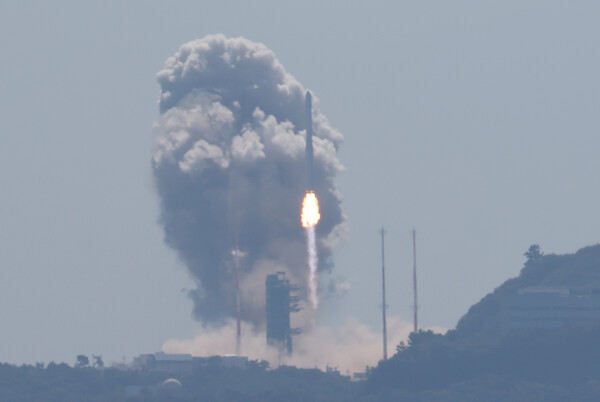
South Korea’s homegrown Nuriho launch vehicle separated all 15 satellites it carried on its fifth launch. With confirmation that Nuriho reached its target orbit, only a detailed analysis of flight information remains to determine final success.
Nuriho lifted off at 12:25 p.m. on Oct. 7 from the Naro Space Center in Goheung, South Jeolla Province. After launch, it separated the first stage, the payload fairing and the second stage in sequence, as planned.
About 12 minutes 30 seconds after liftoff, the third-stage engine burn ended. Nuriho reached its target altitude of about 575 km and began separating the payload satellites.
First, 5 main payload satellites, microsatellite constellation units No. 2 to No. 6, were separated one by one at intervals of 35 to 40 seconds.
To prevent collisions between satellites, a separation method was also applied in which the upper part of the launch vehicle was rotated by 30 degrees or 60 degrees each time a satellite was released.
Deploying the 5 microsatellite constellation units into an orbit at an altitude of about 570 km is the core mission of Nuriho’s fifth launch. In the fourth launch, there was 1 main payload satellite, but the number increased to 5 for this launch.
After the microsatellite constellation separation ended, 10 CubeSats were deployed sequentially. With 2 CubeSats separating at 10-second intervals, the separation procedure for all 15 satellites carried on Nuriho was completed.
The Korea Aerospace Administration also said it had confirmed that Nuriho reached its planned orbit.
Oh Tae-seok (오태석), administrator of the Korea Aerospace Administration, said at a 1 p.m. briefing that this was the first time in the launch history that liftoff occurred at the scheduled time. He said that based on flight information and video, Nuriho was confirmed to have reached the target orbit according to the planned flight procedures.
He added that satellite separation was presumed to have been carried out normally according to the original plan.
The Korea Aerospace Research Institute is now conducting a detailed analysis of telemetry received during Nuriho’s flight. It plans to determine final success for the fifth launch by combining satellite separation and launch vehicle flight data.
After completing its mission, Nuriho’s third stage carried out follow-up actions including an avoidance maneuver to prevent collisions with the separated satellites, and venting of remaining fuel and gas.
Oh said follow-up actions had been completed to vent remaining gases, including oxidizer and helium, to prevent collisions with the separated satellites and spontaneous explosions in orbit.
The Korea Aerospace Administration plans to hold a detailed briefing at 2 p.m. and announce the results of flight-data analysis and whether Nuriho’s fifth launch was successful.
 Sang-yeop Oh
yub@d-today.co.kr
Sang-yeop Oh
yub@d-today.co.kr