
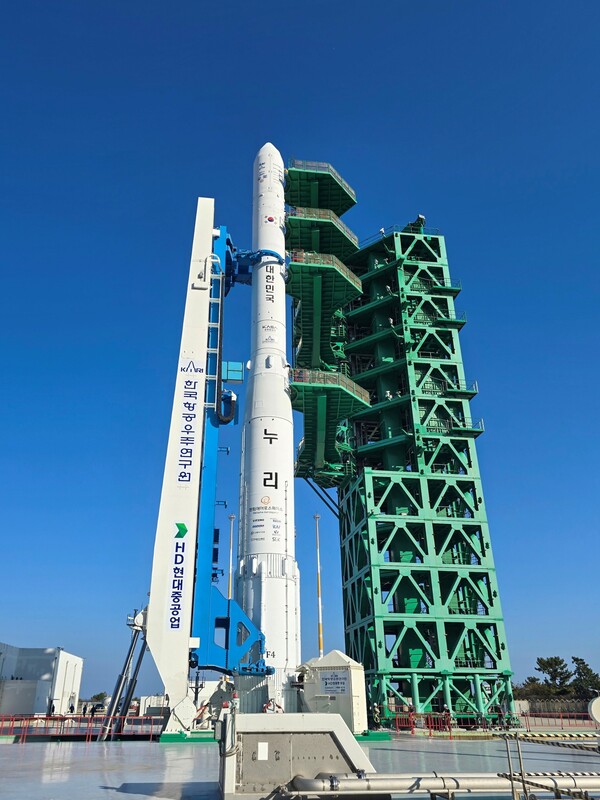
[DigitalToday reporter Yoonseo Lee] South Korea’s homegrown Nuriho (KSLV-II) launch vehicle will attempt its fifth launch on Oct. 7, carrying 15 satellites. After completing installation on the launch pad overnight, Nuriho is preparing for a mission to place 5 nano satellite constellation spacecraft into orbit one by one.
According to the Space Agency and the Korea Aerospace Research Institute, Nuriho completed launch-pad installation work at the Naro Space Center in Goheung at 8:05 p.m. the previous day. After raising and securing the rocket vertically, teams connected an umbilical, a connection device that supplies power and propellants, and completed preparations including leak checks. Strong winds required a cautious approach, and completion took longer than initially expected.
The available launch window is from 12:23 p.m. to 1:23 p.m. on the day. The Space Agency will decide the final launch time at a morning launch management committee meeting after comprehensively reviewing technical readiness, weather, the space environment and the possibility of collisions with space objects.
The payload includes 5 NEONSat nano satellite constellation spacecraft, units 2 to 6, and 10 CubeSats. The total of 15 is the highest number in Nuriho’s launch history.
The core of the mission is to place 5 NEONSats, which will perform the same observation mission, into orbit sequentially. They are planned to separate in different directions at intervals of 35 to 40 seconds to prevent collisions. A low-shock satellite separation device was also newly applied to reduce the impact delivered to the satellites during separation.
Ground images captured by NEONSat are expected to be used for national security and disaster response, including wildfires and floods. The Space Agency plans to add another 5 satellites in Nuriho’s sixth launch in 2027, following the 5 launched this time, to build a constellation operation system of 10 satellites in total. Once the constellation is complete, it will be able to photograph the Korean Peninsula more than 3 times a day.
The CubeSats launched together will take on a range of missions, including verifying space-environment performance of domestically made devices and components, surveying the low-Earth-orbit space environment, monitoring ocean currents and analyzing fine dust.
The Space Agency plans to announce the results of Nuriho’s mission about 1 hour 30 minutes after launch. The success of the launch will be judged based on whether the 5 primary payload satellites were normally injected into the target orbit.
 Yoonseo Lee
yslee@d-today.co.kr
Yoonseo Lee
yslee@d-today.co.kr