
Discussion on institutionalising a won-backed stablecoin is expanding beyond issuers to how to build real-world use cases and distribution infrastructure. Calls are growing for institutional safeguards that ensure financial stability and user protection while also developing new demand such as tokenised securities, cross-border payments and artificial intelligence (AI)-based micropayments.
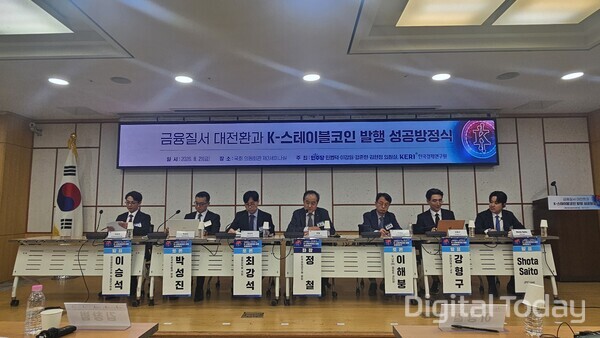
Real-world use cases, an institutional foundation and distribution infrastructure were presented as key tasks at a National Assembly forum titled "A major shift in the financial order and a success formula for issuing K-stablecoins" hosted on Aug. 21 by the offices of Democratic Party lawmakers Min Byung-duk, Lee Kang-il, Kang Jun-hyun and Kim Hyun-jung and the Korea Economic Research Institute.
Jung Chul (정철), president of the Korea Economic Research Institute, who chaired the forum, stressed the discussion should not stop at whether to issue a won stablecoin. He said it is necessary to examine where it can actually be used, whether it can be redeemed, and trust in reserve assets and issuers. He also suggested thinking beyond domestic use to a structure in which foreigners can use a won stablecoin and ways to exchange it for stablecoins from other countries.
Financial authorities said it is necessary to review a stablecoin's economic benefits and its impact on financial stability together from the institutional design stage.
Choi Kang-seok (최강석), head of the Virtual Asset Supervision Bureau at the Financial Supervisory Service, mentioned the possibility of weakened credit supply functions due to an outflow of funds from banks and the effect of reducing costs for overseas remittances and settlement of accounts receivable. "We need to consider these things from the institutional design stage and think about them together," he said. The watchdog said it would communicate with the market during future legislation and follow-up discussions.
In the industry, there were calls that it is important to build infrastructure that enables actual exchange, circulation and settlement of won stablecoins, not just issuance.
Lee Hae-bung (이해붕), head of the Investor Protection Center at Dunamu's Upbit, stressed that discussions are needed not only on issuance but also on distribution infrastructure. He said costs may arise in micropayment processes if stablecoins are traded on-chain, and argued that digital asset exchanges could serve as liquidity hubs. He said real-world use could expand from physical purchases to Web2 and Web3 agents and cross-border payments in global trade and finance.
The financial investment industry focused on the possibility of combining stablecoins with tokenised securities. Park Sung-jin (박성진), head of the Digital Asset Strategy Department at Korea Investment & Securities, pointed to a gap in which tokenised securities move in seconds on blockchain while payment settlement is still carried out through bank and brokerage accounts on a business-day basis.
He said that if it becomes possible to settle tokenised securities payments with stablecoins in the future, it could fill this "last blank". He also said that in the retail market, creating new services using smart contracts could be a catalyst for wider adoption of stablecoins.
Min, a lawmaker who attended the event, said, "Institutions should be a foothold for innovation and must not hold it back. At the same time, innovation without trust should not be left to the market." He added, "Creating a playground where companies and developers can fully play within a safe fence, that will be the role of the state and the National Assembly."
 Ji-young Lee
ljy@d-today.co.kr
Ji-young Lee
ljy@d-today.co.kr