
South Korea's National AI Strategy Committee will set a government-wide legislative direction centred on the AI Basic Law to meet rising demand for AI-related legislation after the law takes effect.
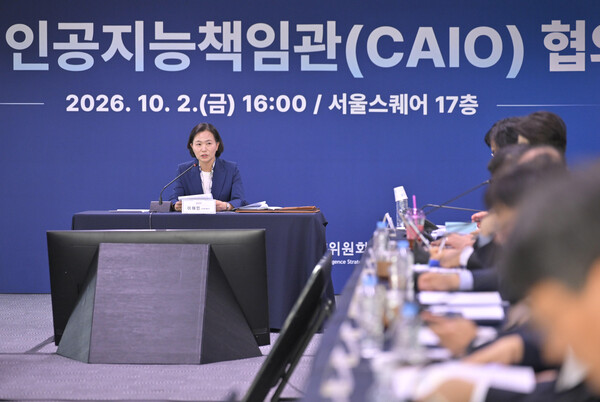
The committee said on Oct. 2 it held the fifth Chief AI Officer (CAIO) meeting at Seoul Square and discussed a draft "Republic of Korea AI Legislative Framework" and other items.
The legislative framework sets four basic directions: legislation centred on the AI Basic Law, closing legislative gaps in defence and security, improving predictability for businesses, and an immediate response when adverse effects occur. Based on that, it set legislative principles by area, including promoting AI development and AI convergence, ensuring AI safety and trust, and preventing misuse and abuse of AI.
The meeting also shared preparations for "AI for Everyone", which is set for a formal nationwide launch for the public in December. The Ministry of Science and ICT asked related agencies to cooperate by linking existing open public application programming interfaces (APIs) to install public AI agents and by opening additional non-open APIs and data.
Participants also discussed setting standards for processing and using personal data by AI agents, as well as measures to verify service security and safety.
The Ministry of the Interior and Safety requested that ministries register and share high-value data and identify demand for combined data in connection with the government-wide data pipeline that opened on Sept. 18. The Personal Information Protection Commission discussed building a comprehensive, ministry-by-ministry personal information protection and security management system to respond to major hacking and data leak incidents in the public and private sectors, as well as measures to strengthen the role of chief privacy officers (CPOs).
The meeting was the first chaired by Lee Hae-min (이해민) as head of the CAIO meeting. Attendance was expanded to 42 central administrative agencies from the previous 28 ministerial-level bodies, adding 14 vice minister-level agencies including the Ministry of Personnel Management, the Ministry of Government Legislation and the National Data Agency.
Lee said, "The CAIO meeting is a place that connects the seams between ministries," adding, "As chair, I will personally take care so that the meeting does not stop at hearing reports, but can become a consultative body that coordinates and decides issues between ministries."
 Seulgi Son
sageson@d-today.co.kr
Seulgi Son
sageson@d-today.co.kr