
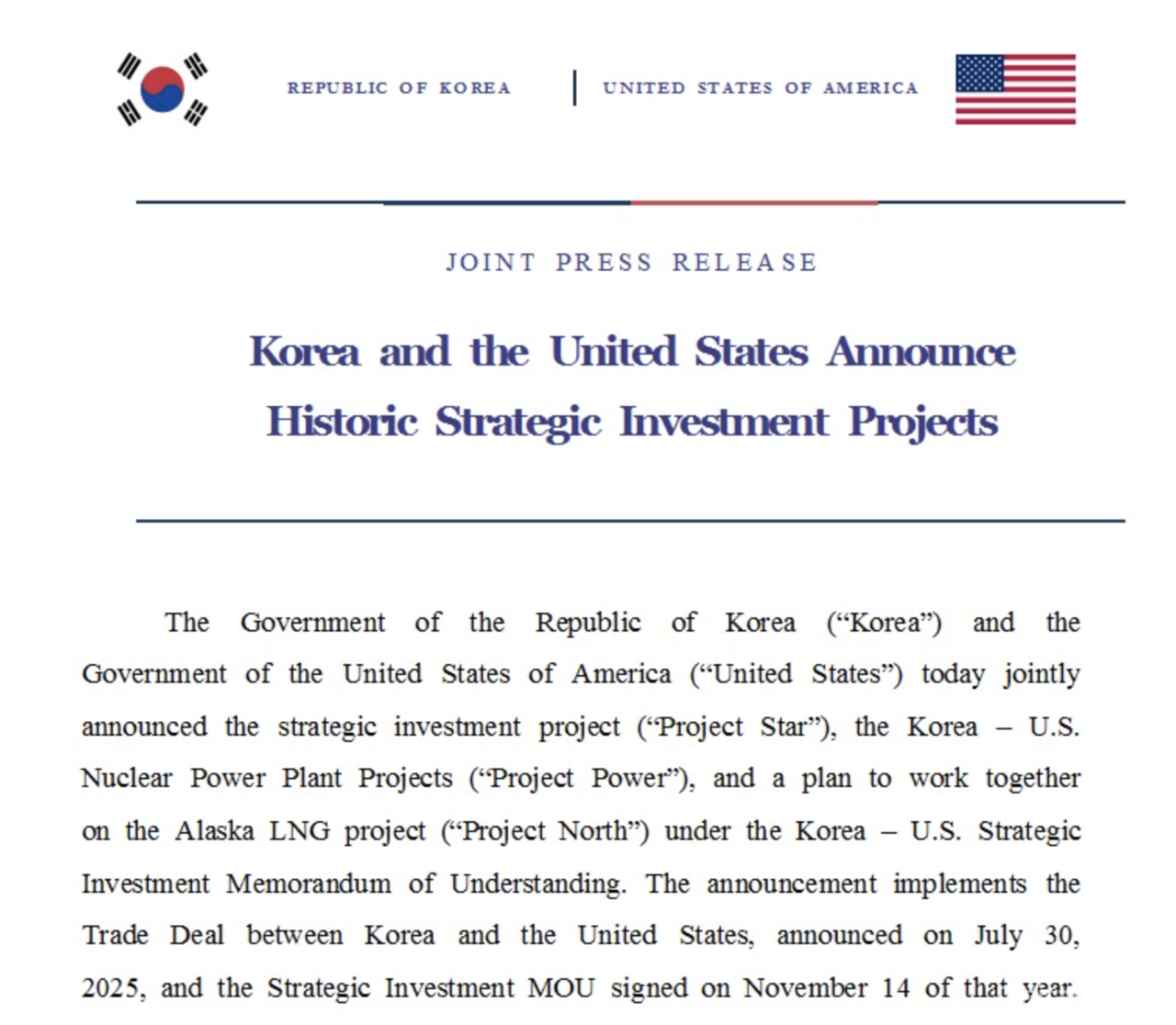
The first South Korea-U.S. strategic investment projects have been set in three areas: AI power, nuclear power and LNG. The South Korean and U.S. governments on Wednesday announced plans to 추진 Project Star, a gas-fired combined-cycle power plant in Texas, a South Korea-U.S. nuclear framework dubbed Project Power, and an Alaska LNG plan dubbed Project North. The government said the measures are follow-up steps to a trade agreement in July last year and an investment memorandum of understanding in November and that related procedures, including steps under the South Korea-U.S. Strategic Investment Act, have been completed.
Project Star is a plan to build a power plant for an AI data center in Encinal, Texas. Total project costs are $22.3 billion and capacity is 6,472 megawatts. The plant will directly supply electricity to nearby data centers. It will begin first-stage commercial operations in 2029 and move to full operations in 2032.
Real estate developer Related Companies and power producer NextEra Energy will lead the project. Natural gas supplier Lewis Energy Group will handle the site as well as gas and water infrastructure. South Korean companies can take part in equipment supply, design and construction, and operations and maintenance. The United States said it intends to provide opportunities to supply South Korean-made equipment, including turbines, to similar projects.
Project Power is a plan to build 8 large nuclear reactors in the United States with up to $120 billion from a South Korea-U.S. strategic investment fund. It includes 2 APR1400 units and 6 AP1000 units. It comprises $100 billion in construction costs plus $20 billion in contingency reserves. The Korean APR1400 had been blocked from entering the U.S. market because of a settlement agreement between companies, but it was included as a foreign design to be built in the United States for the first time.
The two sides also discussed securing items that take a long time to manufacture, such as reactor pressure vessels, by paying up to $10 billion first by year-end. They will also push for South Korean companies to acquire a stake in Westinghouse, with terms to be set through negotiations between companies. Individual projects, including sites and timelines, will be finally decided after reviews of commercial viability and parliamentary procedures.
S. Korea-U.S. confirm three major investment projects; $22.3 billion power plant is first
The Alaska LNG plan involves building a pipeline to move natural gas from the north to the south and an LNG terminal for exports. The two countries decided to begin reviewing the project. They will determine whether to proceed if it meets commercial viability and domestic legal requirements. If the project goes ahead, the United States will lower tariffs on equipment such as steel, guarantee long-term purchase contracts on economically viable terms, and grant South Korea priority access to LNG produced.
All projects will be pursued through an umbrella special-purpose vehicle, I-SPV, and project-specific P-SPV structures. The I-SPV will integrate funding and profit distribution management, and P-SPVs that receive full capital contributions will carry out individual projects. The distribution ratio will remain 50-50 until South Korea recovers all principal and interest on its investment, and a shift to a 10-90 ratio has been put on hold.
An investment limit of $20 billion a year, totaling $200 billion, was specified in the operating contract. If business viability is damaged, the sides will discuss adjusting the distribution ratio at intergovernmental meetings. Income tax paid to the United States will be added to South Korea's distributed amount. The deal also secured consent rights over major project changes.
Industry Minister Kim Jeong-gwan (김정관) said, "This announcement of the South Korea-U.S. strategic investment projects goes beyond simply implementing the South Korea-U.S. tariff agreement. It opens a new horizon of cooperation by combining the strengths of both countries to create businesses together in strategic areas directly linked to future industries and economic security, such as AI, nuclear power and LNG." He added, "As valuable taxpayers' money is being投入, we will uphold the principle of investing only in commercially viable projects with the national interest as the top priority, and we will create a virtuous cycle in which South Korea-U.S. strategic investment leads to growth and stronger competitiveness for our companies."
 Daegeon Seok
d2dg@d-today.co.kr
Daegeon Seok
d2dg@d-today.co.kr