
As debate spreads in the global AI industry over the pace of development, some say South Korea should raise the pace of responsibility, such as verification, control, incident response and resilience, rather than slow frontier AI development itself.
They argue that amid U.S.-China AI competition, South Korea should not take sides but should pre-empt AI safety standards that both sides need and play a central role in global solidarity. The idea is solidarity based on function, not rules.
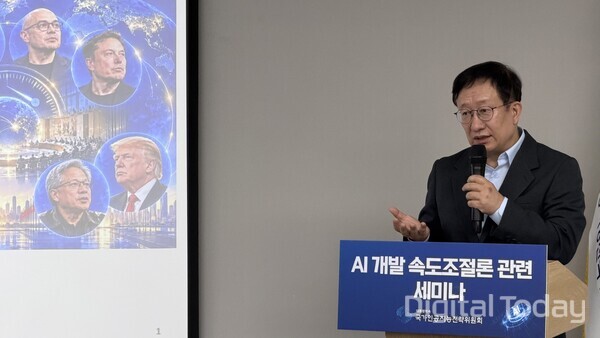
Lee Won-tae (이원태), chair of the Security Special Committee at the National AI Strategy Committee, said at a seminar on the AI development speed-control debate held on Wednesday at Seoul Square in central Seoul, "Rather than normative solidarity that has any camp or values in mind, we should capture what they regret or hope for and pursue functional solidarity."
Lee said it is necessary to note that AI has begun making better AI on its own.
He said assessing AI risks should consider not only model performance but also autonomy and the speed at which it improves its own capabilities.
He stressed that the recent speed-control debate should not be interpreted as a call to halt AI development entirely. He said the call by Dario Amodei, CEO of Anthropic, that "We must pace the frontier" also places emphasis on securing controllable time by adjusting the pace of verification, diffusion and empowerment, rather than stopping development itself.
Lee said, "The core of the debate is not whether to slow AI, but whether to let it run at an uncontrollable speed," and added, "We should adjust the speed of verification, diffusion and authority so that safety and control capabilities also develop."
He said South Korea therefore needs to flesh out the "speed responsibility" idea previously presented by Bae Kyung-hoon, deputy prime minister and science and ICT minister.
Lee said, "South Korea's answer is not speed control but speed responsibility," adding, "We should never slow frontier models and industrial use, but we should make the pace of responsibility, such as verification, incident reporting and resilience, faster than the pace at which risks grow."
He added, "Safety is not the opposite of acceleration but a condition for acceleration," and stressed that "a competitive AI is not simply an AI with high performance, but one that can be deployed safely and recover even when an incident occurs."
◆ 'Functional solidarity' instead of choosing between U.S. and China...South Korea's role between the 'AI umbrellas'
The seminar also discussed what role South Korea should take in international AI safety governance.
Lee pointed to a limitation in the separation between bilateral competition between the United States and China, which possess cutting-edge AI models, and multilateral safety talks led by middle powers. He laid out an idea for South Korea to proactively design an incident classification system and evaluation standards, incident notification procedures, human control and resilience that both the United States and China need, rather than choosing one side.
Lee said, "South Korea's role is not in choosing one side between the United States and China," adding, "We should design functional common denominators that the United States and China, as well as various multilateral coalitions, can empathise with and accept, and present alternatives in a leading way on the international stage."
He meant South Korea should step forward as a "co-designer" that creates standards for AI safety evaluation and control and incident response, rather than following and accepting finished international standards.
Kim Myung-joo (김명주), head of the AI Safety Institute, also compared AI to a de facto "digital nuclear weapon" and stressed the need for an international cooperation system. He said that as the United States and China engage in camp competition around their respective "AI umbrellas," similar to the nuclear umbrella during the Cold War, South Korea should build independent verification and evaluation capabilities and play a more active role in international cooperation.
Voices from industry also called for a multilateral cooperation structure rather than allowing a particular country or company to lead international norms monopolistically.
Kim Dong-hwan (김동환), CEO of FortyTwoMaru, said, "We should build a multilateral cooperation system through international organisations in various fields so it does not represent the interests of any particular company or country," adding, "South Korea should demonstrate global leadership in the international community in establishing international safety norms."
◆ 'Model scores alone do not show real capability'...Korean-style evaluation standards also a task
Some also said that raising the "pace of responsibility" requires changing how AI is evaluated.
Choi Dae-sun (최대선), head of the AI Safety Research Center at Soongsil University, said that judging AI capability and risk mainly by benchmark scores of individual models, as is currently done, could underestimate what a real system can deliver.
He said even with the same model, performance can change significantly if multiple agents and external tools are connected and additional resources and authority are granted. He said relatively small or easily accessible models can also gain high-level cyberattack capabilities depending on combinations of agents and tools.
Choi said, "We must not think only in a model-centric way, but assess the capabilities of the overall solution."
He said an entire AI system should be evaluated independently and objectively, including agents, external tools and real actions, rather than only measuring a model's performance. He said the scope of safety evaluation should also include access control and behaviour monitoring, stopping operation and revoking authority when an incident occurs, and log preservation and recovery.
There were also calls for South Korea to establish its own benchmarks and evaluation standards.
Lee Han-ul (이한울), vice president at AIM Intelligence, stressed that capabilities to judge what level a top-tier AI model actually is and how risky it is are as important as securing such models.
He said safety is not automatically guaranteed simply because a model is developed domestically, and South Korea should not stop at adopting foreign evaluation standards 그대로 but should prepare evaluation conditions and verification methods suited to the domestic environment and threat level.
He also said it is important to build up and share experience and incident information on using AI safely. He said, "Experience must accumulate on how vulnerabilities were actually discovered and responded to so that South Korea can have its own standards and grounds and speak up in international AI safety discussions."
◆ 'A chaser falls behind if it stops'...'SI^2' era, the field should move to risk-based management
Some in industry, meanwhile, raised concerns that slowing the pace of frontier technology development because of AI safety discussions could widen the gap between South Korea, a latecomer, and the leading group even faster.
Kim Sung-hoon (김성훈), CEO of Upstage, said AI development is accelerating at a different level from the past as AI moves beyond supporting human research and development and is being投入 into AI development itself.
Kim described in his presentation a stage in which super intelligence (Super Intelligence, SI) is投入 again into AI development to accelerate technological progress as "SI^2." He said that if recursive self-improvement in which AI develops AI becomes full-scale, the gap between leaders and chasers could also widen far faster than before.
Kim said, "A chaser falls behind if it stops," stressing that South Korea should also continue securing frontier AI capabilities.
Kim Dong-hwan also said he agrees with the need for speed control, but saw uniform development restrictions as unrealistic.
He said, "The pace of technological progress far outstrips the pace of social institutions and ethical consensus, so I strongly agree on the need, but it is unrealistic," and added, "We should pursue fostering the AI industry and establishing safety devices in parallel."
Instead, he proposed a "risk-based" management system that varies the strength of management depending on AI risk levels on the premise of safety and reliability. He said technical safety devices to control risks such as hallucinations and data leaks should first be put in place in public and industrial settings, then the use of agentic AI, for which control and verification are possible, should be expanded.
A problem is that even if good AI security technology is secured, it can be hard to apply immediately in companies.
Lee Han-ul said that in many companies, security teams that find vulnerabilities are separated from development and operations teams that have authority to change actual services, and that it can be difficult to fix discovered vulnerabilities right away because applying patches could cause disruptions to existing services.
Experts commonly pointed out that ultimately, to link AI security technology to actual security improvements, companies' overall operating systems must also change, including pre-application verification and 장애 대응, patch authority and who is responsible.
 Seulgi Son
sageson@d-today.co.kr
Seulgi Son
sageson@d-today.co.kr