
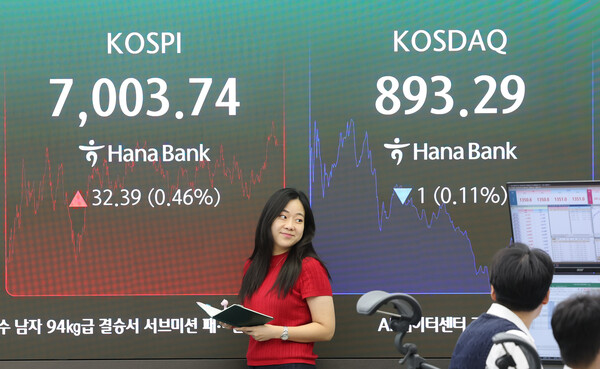
The KOSPI is moving above and below the 7,000 level without finding a clear direction. Semiconductor earnings and exports are holding up, but pressure from interest rates and oil prices is pulling the index up and down, keeping the market in a dull trading range.
The Korea Exchange said the KOSPI has recently recovered the 7,000 level, slipped back and then moved toward 7,000 again in a repeated pattern. The index is not breaking down sharply, but it also lacks the momentum to clearly push above 7,000 and establish an upward trend.
The market views this as a tug of war between corporate earnings and external variables. Profit 전망 for companies remains solid, centered on AI and semiconductors, but high U.S. long-term rates and international oil prices are blocking an improvement in valuations. Earnings are supporting the lower end of the index, while rates are capping the upper end.
A recent slowdown in U.S. employment is, for now, positive for stocks. As the labor market cools, the burden of additional rate hikes has eased, and U.S. Treasury yields have shown some signs of stabilization. That means the likelihood has fallen that the discount-rate pressure that has weighed on South Korean stocks will intensify further.
At home, semiconductor earnings momentum remains a main support for the index. South Korea's September exports rose sharply, and semiconductor exports also posted strong growth. Micron also presented revenue that beat market expectations and issued guidance in its recent results announcement, confirming that memory demand centered on AI data centers is continuing.
Even so, these positives have not yet lifted the KOSPI above its trading range. Expectations for improving semiconductor conditions are already reflected to a significant extent in share prices, and investors appear to be waiting for new catalysts. The pattern has also repeated in which the index rises strongly for a day but then gives back gains as profit-taking emerges in the next session.
The most important variable this week is Samsung Electronics' preliminary third-quarter earnings. Market attention is expected to focus less on the size of operating profit itself and more on how much higher memory prices and AI demand are reflected in actual results.
Samsung Electronics' third-quarter operating profit forecasts have recently edged down from their peak. The drop reflects concerns about the exchange rate, memory prices and profitability at some business divisions. If results meet or beat the lowered market bar, confidence in semiconductor earnings could rise again and provide a chance for the KOSPI to settle above 7,000.
If results fall short of expectations or guidance is presented conservatively, the recently repeated range-bound move could last longer. With semiconductors accounting for a large share of KOSPI earnings, Samsung Electronics' results affect not only the stock itself but also profit forecasts for the broader index.
The industry sees changes in forward profit outlooks becoming more important than third-quarter numbers starting this earnings season. That implies a higher chance of wider stock-price differentiation after results between companies whose next-year earnings forecasts are revised up and those that are not.
Rotation into sectors beyond semiconductors is also in focus. Recently, with the index stalled near 7,000, buying has shifted into some sectors including machinery, shipbuilding, insurance, and retail and distribution. Even if the index does not move much, the gap in returns by sector and stock could widen in this phase.
A similar pattern is expected for the KOSDAQ. Rather than a strong rise in the overall index, funds could move selectively into small and mid-cap stocks with confirmed earnings, AI infrastructure, and semiconductor materials, parts and equipment.
Interest rates remain a variable. The risk of additional tightening has eased due to a U.S. employment slowdown, but if international oil prices stay high, inflation and long-term rates could rise again. As the domestic stock market has recently reacted sensitively to rate moves as much as to corporate earnings, there is a need to keep checking the direction of U.S. Treasury yields.
Ultimately, the key for the market this week is whether the KOSPI can break out of the dull battle around 7,000. If Samsung Electronics' results bolster trust in improving semiconductor profits and U.S. rates also stabilize, the index could try to settle above 7,000 and extend gains. If neither earnings nor rates provide a clear direction, a range-bound market centered on 7,000 is likely to continue for some time.
Lee Kyung-min (이경민), a researcher at Daishin Securities, said it is necessary to watch Samsung Electronics' preliminary results announcement to maintain the rising mood. He said rising memory prices, resilient South Korean exports and Micron results are positive factors for Samsung Electronics' earnings.
Noh Dong-gil (노동길), a research committee member at Shinhan Investment Corp, said attention to third-quarter earnings will expand from early October. He said what matters more is to confirm after earnings announcements whether third-quarter results have made the bottom more solid by looking at changes in profit forecasts, and then shift focus to next year.
Lee Jae-won (이재원), a researcher at Yuanta Securities, said it is necessary to look at which sectors have profits that can withstand high rates, rather than expecting high rates to disappear quickly. He said an approach centered on sectors where actual capital expenditure and profits are both confirmed remains valid, including AI infrastructure and power infrastructure centered on semiconductors.
 Sangyeop Oh
yub@d-today.co.kr
Sangyeop Oh
yub@d-today.co.kr