
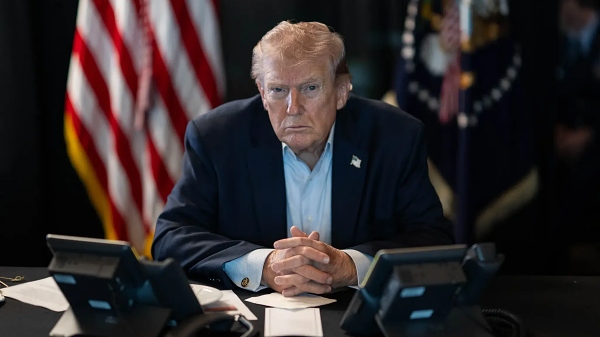
U.S. President Donald Trump repeatedly urged the Senate to swiftly process the Clarity bill, a cryptocurrency market structure measure.
On Aug. 19 local time, blockchain outlet Cointelegraph reported that Trump said at a White House news conference that the Senate should pass a “fair version” of the Clarity bill. Crypto industry figures attended the event, including Coinbase CEO Brian Armstrong (브라이언 암스트롱) and Gemini co-founders Cameron and Tyler Winklevoss (캐머런·타일러 윙클보스).
Trump linked the need to move the bill to competition with China. He stressed that the bill must be processed for the United States to stay ahead of China.
The Clarity bill passed the House in July 2025, but it has made no progress for months in the Senate amid concerns over tokenised stocks, stablecoin rewards and potential conflicts of interest between the Trump family and the crypto industry.
The news conference also highlighted the need for the bill’s long-term sustainability and bipartisan support. Armstrong said he expected the bill to strengthen the foundation of U.S. crypto policy so it lasts for decades. He also forecast that the Senate could secure the 60 votes needed for passage if it puts a motion to end debate to a vote on Sept. 18.
Trump also mentioned the possibility of bipartisan support. After Armstrong’s remarks, he said the Clarity bill was “very bipartisan” and had a lot of support among Democrats. With the Senate currently in recess, he has joined industry executives in pressing for legislation.
Moves by regulators are also continuing. The news conference was held a day before a meeting of the U.S. Commodity Futures Trading Commission’s Innovation Advisory Committee. CFTC Chairman Michael Selig (마이클 셀릭) said the committee’s meeting would be used to advance discussions on crypto regulation while Congress is in recess for about a month.
The U.S. Securities and Exchange Commission also proposed a separate regulatory plan in the same week. The plan includes providing companies with a safe harbour so some tokens are not regarded as “investment contracts”, and setting certain exceptions for token issuance. As legislation is delayed, regulators are also moving to refine their own rules.
In this situation, the direction of the Clarity bill remains a factor that could determine the course of the U.S. crypto regulatory framework. With the Senate’s vote schedule and follow-up steps by the CFTC and SEC intersecting, whether market structure legislation and administrative regulation proceed in parallel is expected to be the next point to watch.
 Yoonseo Lee
yslee@d-today.co.kr
Yoonseo Lee
yslee@d-today.co.kr