
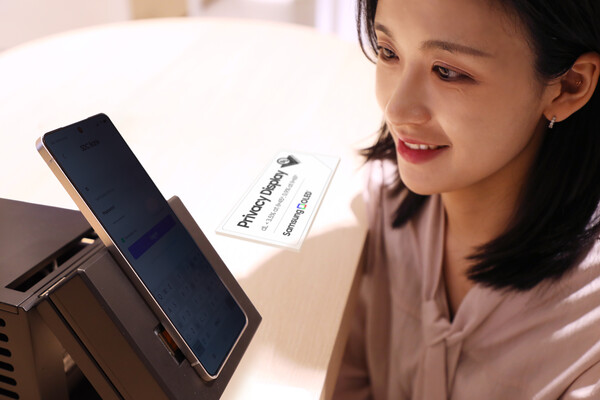
Samsung Display said on Wednesday its smartphone OLED using its panel-integrated privacy technology, Flex Magic Pixel (FMP), passed UL Solutions' "privacy display" verification. FMP is a technology that makes the screen appear clear from the front but blurry or almost invisible from the side.
UL Solutions said it evaluated performance by rotating the panel 360 degrees while it was tilted at 45 degrees and 60 degrees, measuring how much screen brightness decreased versus the front. Side luminance of Samsung's OLED with FMP was 3.5 percent of the front at 45 degrees and 0.9 percent or less at 60 degrees. That means if front brightness is assumed to be 100, brightness at 45 degrees to the side is about 3.5.
As data use increases in the AI era, concerns have grown about personal information leaks and privacy exposure through smartphones in public places, and global set makers are showing more interest in the technology. A company official said many people previously bought separate protective films and attached them to smartphones due to privacy concerns, but such films have the drawback of reducing screen brightness even when the privacy function is not needed. The official said FMP controls viewing angles at the pixel level and allows the privacy function to be turned on and off, so when the function is off, users can enjoy strong picture quality without any reduction in brightness even when viewing from the front.
FMP is based on panel design technology and a fine deposition process that control subpixels just a few micrometres in size to adjust the degree of light diffusion. Samsung Display has built up its technological competitiveness since 2020 by filing around 150 patent applications for core technologies needed to implement FMP.
Samsung Display changed the black matrix (BM) design structure to adjust the degree of light diffusion from some subpixels. BM is a core OLED structure that distinguishes each RGB subpixel and prevents colour mixing between subpixels. It is generally a single layer, but Samsung Display developed a "multi-shading structure" in which BMs are arranged in multiple layers.
It completed the FMP technology by combining it with its non-polariser OLED technology, "LEAD", which has strong high-brightness and low-power-consumption characteristics. Samsung Display is promoting it to customers as "LEAD 2.0", meaning an advanced technology of LEAD.
Lee Ho-jung (이호중), vice president and head of the product planning team at Samsung Display's small and medium display business, said "LEAD 2.0" maximises security performance by blocking viewing angles in all directions, while also improving power efficiency, the biggest challenge in the on-device AI era. He said the company will continue to focus on developing new technologies to improve smartphone user convenience.
 Daegeon Seok
d2dg@d-today.co.kr
Daegeon Seok
d2dg@d-today.co.kr