
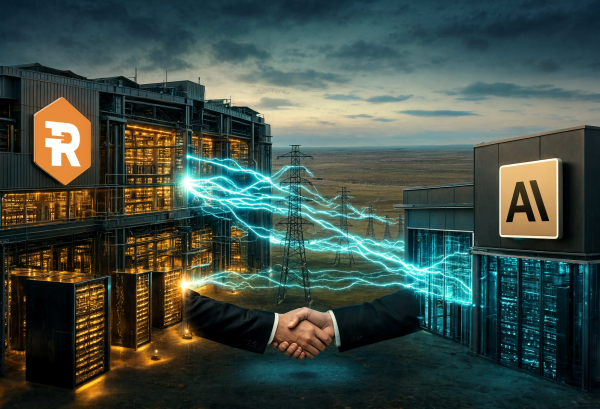
Riot Platforms, a U.S. bitcoin miner, decides to sell 4,300 bitcoins it holds and invest the proceeds in expanding its datacentre network for artificial intelligence workloads.
A blockchain outlet, U.Today, reports on Aug. 13 that the decision shows a shift by major miners away from accumulating cryptocurrencies and toward a computing infrastructure business.
The direct backdrop is weaker mining profitability. Riot’s second-quarter mining revenue falls 19.3 percent due to higher electricity costs and a sharp drop in hashprice.
Market conditions are also challenging. Bitcoin trades in a narrow range of $63,500 to $63,700, but industry models estimate average mining costs at $76,000 to $78,000 per bitcoin. As a result, the average network miner is assessed to be operating at a loss.
Hashprice also falls to a record low of $30 to $35 a day per petahash per second. Only operators that secure low electricity rates and the latest equipment can maintain profitability.
Riot’s mining costs are lower than the market average, but pressure increases. The company’s direct mining cost per bitcoin rises to $49,912 due to higher power prices and the impact of facility expansion in Kentucky. Riot posts $113.7 million in mining revenue while raising funds by selling part of the bitcoin it accumulated.
It maintains financial capacity. Riot holds $1.2 billion of cash-equivalent assets, including $548.9 million in cash and 11,380 bitcoins. It sells part of its bitcoin holdings, but still has funding capacity that can be used for additional investment.
Its business model is also gradually changing. Riot has already provided its first facility capacity to AMD, and a 20-year lease contract targeting an AI research facility is presented as a key long-term project. Expected revenue from the contract is $9.1 billion. This suggests it is shifting its business structure to infrastructure income based on long-term contracts rather than simple mining.
The change is not limited to Riot. In 2026, major miners show a trend of shifting from mining companies to computing infrastructure operators. Marathon Holdings, Core Scientific and Bitdeer have also previously converted part of their cryptocurrency holdings into cash to raise funds to build AI infrastructure.
Ultimately, the sale can be seen as a change in the mining industry’s profit structure rather than a simple disposal of assets. With bitcoin prices stuck in a narrow range as power cost burdens and falling hashprice overlap, major miners are moving away from a strategy of holding coins and restructuring revenue sources toward long-term contract-based AI datacentre businesses.
 Yoonseo Lee
yslee@d-today.co.kr
Yoonseo Lee
yslee@d-today.co.kr