
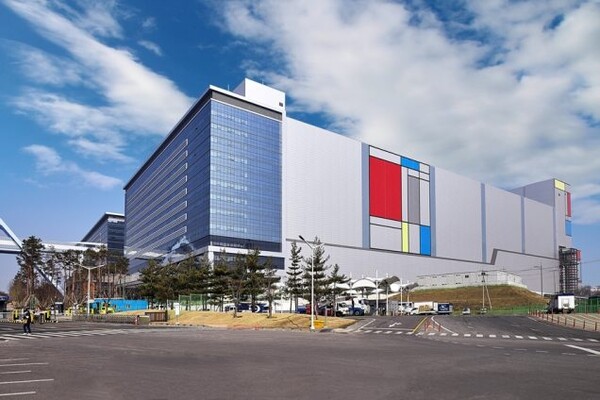
Samsung Electronics and SK Hynix's memory production results this year came close to last year's full-year performance in just three quarters. In the first three quarters, Samsung Electronics reached 89 percent of last year's total, while SK Hynix reached 91 percent. The two companies ran memory production lines for all available hours, maximising output from existing facilities.
According to third-quarter reports disclosed by Samsung Electronics and SK Hynix on the 16th, utilisation rates for both companies' memory production lines were 100 percent. Samsung Electronics' DS division memory business operates 24 hours a day in three shifts, and its operating days in the first three quarters totalled 273 days including holidays. That matched the number of calendar days from January to September, meaning it did not stop the lines for a single day. Samsung sets available operating time by multiplying the number of production lines by 24 hours, and it used all 65,520 hours in the period for actual operation.
At SK Hynix, available operating time and actual operating time were the same at 220,625,496 hours. SK Hynix calculates utilisation by considering staffing levels and yields by region and by fab. The calculation methods differ, but neither company left room to increase production by running existing lines more.
The two companies' volumes have already come close to last year's full-year results. Samsung Electronics' DS division produced 2,043.7 billion units in the first three quarters on a 1Gb equivalent basis. That equals 89 percent of last year's full-year output of 2,245.9 billion units. Given that last year's total output was at a similar level to 2024, when it was 2,238.2 billion units, the pace was fast. If the monthly average pace from the first three quarters continues in the fourth quarter, this year's full-year output will be 2,667.2 billion units, up 19 percent from last year.
SK Hynix followed the same trend. Its semiconductor production performance in the first three quarters was 3,763.37 trillion won, filling 91 percent of last year's full-year 4,121.65 trillion won. Last year's performance was also up 17 percent from 2024, at 3,523.27 trillion won, and this year it reached 91 percent of that with three months remaining. At the same pace, this year's full-year production performance will exceed 5,000 trillion won.
With utilisation already at 100 percent, the two companies are increasing and accelerating facility investment to boost production further. Samsung Electronics' facility investment in the first three quarters was 56.9 trillion won, of which the DS division accounted for 52.8 trillion won. Semiconductor spending made up 93 percent of the company's total facility investment.
Samsung Electronics' quarterly report said it invested mainly in expanding and converting advanced processes and in infrastructure, and it continues investment to strengthen next-generation memory technology competitiveness and prepare for mid- to long-term demand. DS division investment also includes spending to secure production capacity for advanced nodes in system semiconductors. As a result, the company's book value of tangible assets rose to 234.0 trillion won at end-September, up 18.7 trillion won from the end of last year.
SK Hynix invested 31.2 trillion won in acquiring tangible assets over the same period. The company classified this as supplemental investment and cited increased production capacity as an investment effect. The acquisition amount was 2.8 times depreciation expenses of 11.2 trillion won. The book value of tangible assets rose 25 percent in nine months to 97.2 trillion won at end-September.
More than 70 percent of the increase was machinery and equipment, meaning production equipment. The book value of machinery and equipment rose 36 percent from 39.6 trillion won at the start of the year to 53.9 trillion won. Of that, 13.2 trillion won was the amount of completed facilities that replaced construction in progress as machinery and equipment. The pace is fast in moving beyond building plants to filling them with equipment.
Assets under construction that are not yet in operation also increased. At end-September they stood at 69.9 trillion won for Samsung Electronics (company-wide) and 25.1 trillion won for SK Hynix. That was up 23 percent and 15 percent, respectively, from the start of the year. The amount SK Hynix newly put into construction in progress in the first three quarters was 17.9 trillion won, more than the 14.5 trillion won that was replaced by other assets in the same period. Samsung Electronics' company-wide acquisition amount for machinery and equipment was 35.6 trillion won, more than double its acquisition amount for construction in progress of 16.2 trillion won.
 Dae-geon Seok
d2dg@d-today.co.kr