
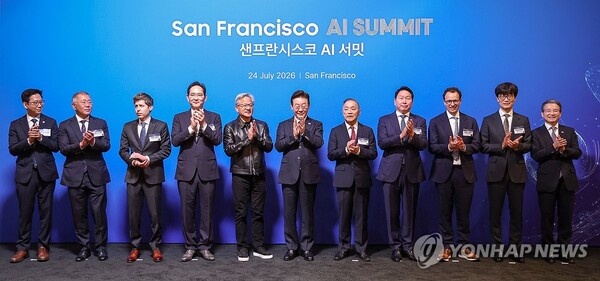
South Korean President Lee Jae-myung (이재명) on July 24 (local time) issued a “San Francisco AI Declaration” in San Francisco and said he would make South Korea an irreplaceable axis of the global artificial intelligence supply chain. He cited a 4,700 trillion won AI project investment announced in June and investment initiatives by domestic and foreign companies whose combined enterprise value exceeds 2 quadrillion won. The targets include memory and foundry semiconductors, autonomous driving and AI factories.
Lee attended the “San Francisco AI Summit” at The Midway in San Francisco and read the declaration. Attendees included Samsung Electronics Chairman Lee Jae-yong (이재용), SK Group Chairman Chey Tae-won (최태원), Hyundai Motor Group Chairman Chung Euisun (정의선) and Naver Chairman Lee Hae-jin (이해진). Overseas participants included Nvidia CEO Jensen Huang, OpenAI CEO Sam Altman, Anthropic CEO Dario Amodei and Broadcom CEO Hock Tan.
The declaration centres on semiconductors. Lee said, “The Republic of Korea will leap into a core country in the irreplaceable global AI supply chain.” He added, “Based on world-class competitiveness and production capacity in memory semiconductors, we will become a trustworthy AI semiconductor production base and supply-chain partner.”
Lee also referred to the structure of production bases. He said, “We announced a large-scale investment plan in June and are shifting to a multipolar production-base system in which the Seoul metropolitan area and regions together take responsibility for global semiconductor supply.” He added, “We will build a world-class AI hub that stably supplies core infrastructure needed by the global AI ecosystem.”
On the demand side, Lee promoted a vision of South Korea as a leading user nation. He said, “Beyond supply, we will become the country that uses AI fastest and most effectively, creating a new market for the world to grow together.” He said South Korea would be a “global AI testbed and production platform” where AI actually operates in manufacturing plants, cities and logistics sites.
Lee also positioned South Korea as a mediator to narrow the gap between leading countries and developing countries. He said, “We will build a horizontal cooperation network with diverse countries to create a new AI market, and enable more countries’ citizens to participate in opportunities from AI innovation.” Citing the AI Basic Act that took effect in January, he also presented a concept of an “AI basic society,” meaning “a society where no one is left behind.”
In closing remarks, Lee said, “Artificial intelligence is like the ‘new fire’ discovered by humanity.” He added, “If South Korea has so far chased advanced countries, now we intend to stand one step ahead and take the path of becoming a model for all.” He also pointed to the link between economic issues and democracy, mentioning the state of martial law incident from about two years ago. He then asked for cooperation from global companies and said, “I dare say you will never be disappointed.”
AI chiefs visit Nvidia headquarters; agenda undisclosed
Corporate contacts also continued around the summit. Nvidia said on July 25 that Lee, Chung and Lee Hae-jin toured its headquarters in Santa Clara, California on July 24 (local time). The three took commemorative photos with Huang in the lobby of the Endeavor building at the headquarters. It was their first meeting in about a month since Huang’s trip to South Korea in June. Nvidia did not disclose the meeting’s contents or agenda.
The industry believes points of contact by business were likely discussed. Since Samsung Electronics supplies Nvidia with high-performance memory including high-bandwidth memory, memory and foundry business were likely key agenda items, according to speculation. Chung was reported to have discussed cooperation plans on autonomous driving, robots and manufacturing AI. Since Huang has referred to Saemangeum, a planned investment site for Hyundai Motor Group, as an “AI valley,” data-centre cooperation may also have been mentioned. Naver executives including CEO Choi Soo-yeon were also expected to have discussed an AI factory buildout project.
Chey held a dinner with Huang in Woodside, California a day before the summit and discussed ways to expand cooperation on AI infrastructure, semiconductors and physical AI. Nvidia and SK agreed in June to broaden cooperation by jointly developing memory for Nvidia’s platform spanning AI infrastructure, personal AI and physical AI. SK Telecom also announced in the same month a plan to build AI infrastructure to support physical AI and robotics.
Cooperation aimed at securing research talent was also announced. Nvidia and the Korea Advanced Institute of Science and Technology (KAIST) said they will establish a joint agentic AI research centre at KAIST Kim Jaechul Graduate School of AI in Seoul. It is the first AI research centre in South Korea to be jointly established by a domestic university and a global technology company. The approach combines Nvidia’s Nemotron open model and computing resources from AI cloud partners with KAIST research staff.
 Daegeon Seok
d2dg@d-today.co.kr
Daegeon Seok
d2dg@d-today.co.kr