
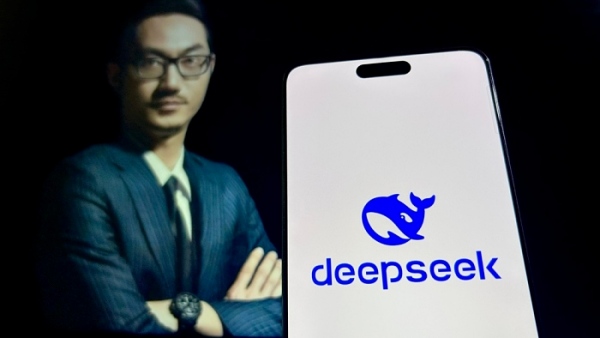
[Digital Today reporter Jinju Hong] Liang Wenfeng, the founder of Chinese artificial intelligence (AI) startup DeepSeek, assessed that the industry’s dependence on Nvidia hardware, long seen as its biggest weakness, is at a turning point. He also forecast that chip supply problems would no longer be a key obstacle to AI competitiveness within the next year.
Blockchain outlet Cryptopolitan reported on July 23 that Liang told investors recently that supply problems would no longer be an obstacle within a year, referring to the possibility of hardware self-reliance in China’s AI industry. The remarks were reported based on minutes of an investor meeting and have not been officially confirmed by DeepSeek or Liang.
Liang said the biggest difference in AI competitiveness between China and the United States lies in resources. He said gaps in talent, model performance and application services ultimately stem from differences in computing resources. He explained that Chinese companies have been unable to secure enough of Nvidia’s most advanced AI chips due to U.S. export restrictions and that funding for AI investment and research staffing is also smaller than in the United States.
He also acknowledged a gap in model scale. Liang said cutting-edge Western AI models use about 800 billion active parameters, while China’s top models remain at the tens of billions level. He assessed that DeepSeek trails leading U.S. companies by 12 to 18 months but delivers similar performance with about one-twentieth of the computing resources. The goal is to narrow that gap to 3 to 6 months.
DeepSeek is strengthening cooperation with Huawei to do so. The company is reported to have secured about 16,000 of Huawei’s Ascend 950 AI chips and is working to optimise its models. Liang assessed that Huawei’s Ascend 950 Supernode can compete with Nvidia’s GB200 and GB300 systems in terms of performance and price.
DeepSeek is also reported to have moved beyond using hardware and entered development of its own AI chips. People familiar with the matter said the company is designing its own inference-only chip and, if commercialised, it could set up a competitive structure against both Nvidia and Huawei.
It is also pursuing software independence. DeepSeek and Chinese researchers are developing their own Tile Language to reduce reliance on Nvidia’s CUDA development platform. Liang forecast that the view in the industry that Chinese AI chips are difficult to use will also change significantly within a year.
Changes are also appearing in China’s AI semiconductor market. Nvidia’s share of China’s AI accelerator market is falling, while local AI chip companies are reported to have logged a 41 percent market share last year and shipped about 1.65 million AI accelerator cards.
Alibaba has also deployed its in-house AI processor, Hanguang, on a large scale and released the related software stack as open source. Huawei and Moore Threads are also working to build a software ecosystem to replace Nvidia CUDA. China’s government is also actively supporting the development of domestic AI semiconductors and a software ecosystem to respond to U.S. AI export restrictions.
Against this backdrop, Huawei recently unveiled the Atlas 950 Superpod at the World Artificial Intelligence Conference in Shanghai, connecting 8,192 Ascend chips. Huawei claimed the system delivers up to 6.7 times higher computing performance than Nvidia’s NVL144 and was built without U.S.-made components.
The industry is watching whether these efforts will translate into real commercial competitiveness, as Chinese AI companies accelerate moves not only to reduce dependence on Nvidia but also to build independent AI infrastructure based on their own semiconductor and software ecosystems.
 Jinju Hong
hongjj@d-today.co.kr
Jinju Hong
hongjj@d-today.co.kr