
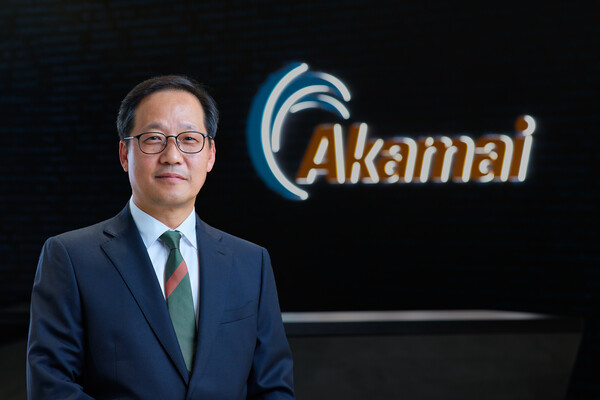
[Digital Today reporter Chi-gyu Hwang] "This year’s goal is to target the financial sector and the public-sector security market. We have already begun discussions with our global headquarters on this. We will also obtain the national certifications needed to enter the public market."
Lee Kyung-joon (이경준), CEO of global IT company Akamai Korea, has drawn attention by setting as a key 2026 goal the targeting of domestic financial and public-sector security markets, which are relatively difficult for foreign companies to penetrate. He judges that the financial sector offers opportunities as network separation regulations are eased. He also sees growing public-sector interest in zero trust as widening the space for overseas companies compared with the past.
In a recent interview with a reporter, Lee said, "We are preparing to obtain the necessary certifications among National Intelligence Service CC (Common Criteria), security suitability assessments and security function verification certificates." He repeatedly stressed that he intends to challenge the public market by putting zero-trust security at the forefront.
The core of Akamai’s zero-trust security strategy is Guardicore, a micro-segmentation product, and EAA (Enterprise Application Access), a cloud-based ZTNA (zero-trust network access) solution.
Micro-segmentation is a technology that divides an IT environment into very small units and finely controls traffic to block the spread of attacks as much as possible. EAA supports secure access to corporate applications without a VPN.
Lee made clear that micro-segmentation is a security product whose importance is growing in an environment where AI is spreading. He said public institutions face the same situation, but solutions provided by domestic security companies remain limited, and Akamai sees conditions forming that make it worth trying.
He said, "In the past, security focused on perimeter security, but now the centre of gravity is shifting to whether you can minimise damage and control it under the assumption that an intrusion has already occurred. The attack surface continues to expand due to AI. AI can attack, and AI can also block attacks. From that perspective, micro-segmentation is an essential product." He added, "There was a perception that micro-segmentation is complex, but it is a matter of perception. Customers who have adopted it say it is easy to use."
Akamai said Samsung Life built a zero-trust security system based on Guardicore to strengthen internal security. It also installed it on PCs in addition to servers, creating a structure that enables employees to work from home, Akamai said.
Lee said, "We are focusing on targeting leading companies by industry. Last year we secured Guardicore references in telecommunications, finance, insurance, automobiles, semiconductors, steel, shipbuilding and telecommunications." He added, "Demand for micro-segmentation continues to grow. As Anthropic Mythos became an issue, responding to Mythos emerged as an important problem among large companies, leading to increased interest in micro-segmentation."
Akamai provides its flagship security products on the cloud as well as on-premises. Demand for on-premises solutions is also high in South Korea due to regulatory issues, he said. Lee said, "Micro-segmentation is evolving from a solution that is good to have in all industries to something that is necessary to have." He added, "We will also pursue lightening it so that small and medium-sized businesses (SMBs), in addition to large companies, can use it."
Akamai, which started with a CDN (Content Delivery Network), began to step up its security business in South Korea around 2010. It began by focusing on security products linked to CDN, including web application firewalls, bot management, content security, account security, DDoS attack blocking and DNS (Domain Name System) security.
It was from 2021 that it expanded into enterprise security, pursued separately from CDN. More recently, it expanded beyond micro-segmentation and EAA into API security and browser security.
It is also active in mergers and acquisitions. It secured EAA through an acquisition, and it entered the browser security market using LayerX, which it acquired in May.
Akamai said LayerX differs from existing secure browsers that require installing a separate browser because it can be used by attaching it to an existing browser. In addition to browser security, it also provides AI security functions, an area that has recently expanded.
Lee said, "LayerX is easy to use and customers do not need to change their infrastructure. It also provides EDR (Endpoint Detection and Response) and DLP (Data Loss Prevention) functions that support endpoint security." He added, "We are also developing in-app AI security and plan to release it as a beta soon."
 Chi-gyu Hwang
delight@d-today.co.kr
Chi-gyu Hwang
delight@d-today.co.kr