
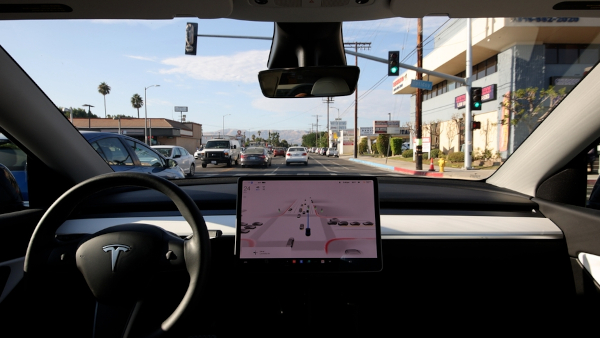
Tesla has still not produced a concrete execution plan for supporting Full Self-Driving (FSD) on Hardware 3 (HW3) vehicles. CEO Elon Musk acknowledged the need to upgrade HW3 vehicles but did not give clear answers on timing, methods or cost sharing.
On July 23, local time, electric vehicle outlet Electrek reported that Musk, asked about HW3 upgrade plans on a conference call for the company’s 2026 second-quarter earnings, said: "It makes sense to upgrade vehicles below HW4."
The question came as Truist analyst Will Stein asked whether Tesla would continue to pursue hardware upgrades so HW3 vehicles can run FSD v15 and later versions. Musk said upgrading HW3 vehicles could someday be financially reasonable, but avoided specifics on when and how it would proceed and how much of the cost Tesla would bear.
The upgrade method has also not been finalised. Musk said the company is reviewing an option to apply a next-generation AI board rather than simply swapping existing HW3 vehicles to HW4. He mentioned the possibility that a next chip improving on HW4 could enter production around mid-next year, and said the next-generation AI5 chip is aiming for mass production in the second half of next year. He added that early production volumes will be prioritised for the humanoid robot Optimus.
Under that plan, the next-generation chip to be used for HW3 vehicle upgrades is not yet at the mass-production stage. Even if production begins, HW3 vehicle support could be delayed further as Optimus is set to take priority over vehicles.
The HW3 controversy is also tied to Tesla’s past promise of "fully self-driving capable vehicles". Tesla has marketed that all vehicles produced since 2016 have the hardware required for full self-driving and has sold FSD for up to $15,000.
Musk later acknowledged that HW3 lacks the performance needed to deliver unsupervised full self-driving. He has said HW3’s memory bandwidth is only one-eighth that of HW4.
Tesla also revised its prior wording that "all vehicles have self-driving hardware" in a shareholder letter in the third quarter of last year. This is seen as a move linked to class-action lawsuits raised in the United States, China and Australia. HW3 vehicles are currently provided with a light version of FSD v14 with some functions limited. The industry views this as a temporary response to offset hardware limits.
The upgrade process itself is also expected to be difficult. With HW3 vehicles numbering in the millions, existing service centres alone would struggle to handle the computer replacement work. Musk earlier this year mentioned even the possibility of building dedicated "microfactories" to retrofit HW3 and acknowledged the existing service network would not be enough, but he did not disclose specific follow-up measures, including that plan, in the latest earnings call.
As a result, the HW3 support issue remains a key challenge that goes beyond a simple technical upgrade, linking to product strategy and consumer compensation. How Tesla closes the gap between past promises at the time of sale and current technical limits has emerged as a factor that could shape trust in the company.
 Jinju Hong
hongjj@d-today.co.kr
Jinju Hong
hongjj@d-today.co.kr