
[Digital Today reporter Dae-geon Seok (석대건)] As TSMC's overwhelming share of the global pure-play foundry market becomes entrenched, a structure is solidifying in which big tech companies placing orders lose out in price negotiations.
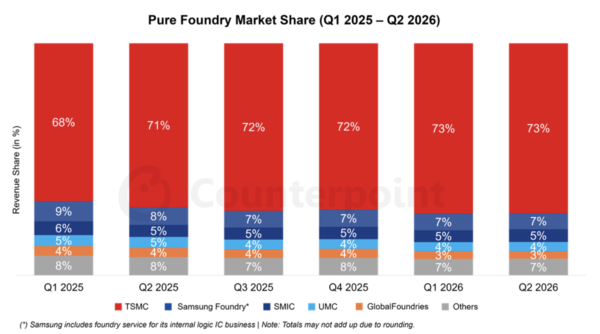
Counterpoint Research said TSMC's share of the global pure-play foundry market stood at 73 percent in the second quarter this year. It was the same figure for a second consecutive quarter. Samsung Electronics' foundry business held on to second place at 7 percent.
Over the same period, the pure-play foundry market grew 29 percent from a year earlier. A foundry is a contract manufacturing business that only produces chips based on orders from semiconductor design companies. Counterpoint Research analysed that a surge in AI-related orders and capacity reallocation prolonged supply-demand imbalances across advanced and mature processes. TSMC maintained its share helped by mass production of 2-nanometre chips, expanded 3-nanometre output, and supply shortages in 8-inch and 12-inch mature processes and advanced packaging.
Samsung's foundry share fell from 8 percent in the second quarter of 2025 to 7 percent in the fourth quarter, then stayed at 7 percent for three consecutive quarters. SMIC ranked third with 5 percent, UMC was fourth with 4 percent and GlobalFoundries was fifth with 3 percent. Yuanta Securities tallied Samsung's foundry share at 6.5 percent in the first quarter of 2026, down 1.2 percentage points from 7.7 percent in the first quarter of 2025.
Amid this concentration, TSMC raised prices. Taiwanese local media reported that TSMC notified major customers such as Apple and AMD of a plan to raise wafer supply prices by 5 to 10 percent for 3-nanometre, 5-nanometre and up to 7-nanometre processes. The same outlet reported that TSMC's order bookings are fully filled through 2028. Yuanta Securities pointed to capacity unable to keep up with demand as the backdrop for the increase.
Samsung's foundry business also raised prices over the same period. Counterpoint Research said wafer price increases in the first half of 2026 and demand for the SF4 and SF5 processes drove revenue growth for Samsung's foundry business. Its second-quarter share was 7 percent, little changed from the first quarter. Revenue rose despite higher prices, and its market share did not move.
Behind the decision is a judgement that its market share would not have changed even if prices had been cut. Samsung's foundry business saw revenue rise in the quarter when it raised prices. If pricing had been a factor blocking orders, it would have been difficult to produce such a result.
Over the same period, the pure-play foundry market expanded 29 percent, and Counterpoint Research projected that rising average selling prices for wafers and high utilisation rates would continue in the second half of 2026. In a market where orders are backlogged and prices are raised, cutting prices alone results in selling the same volume more cheaply. It is not a market with excess line capacity. Taiwanese local media reported that TSMC has filled all order bookings through 2028.
The task Samsung's foundry business is clinging to now is yield. Counterpoint Research said Samsung's foundry business is pushing improvements in yields for its SF2 process as its top priority. Yield refers to how many properly functioning chips can be obtained from a single wafer. If the figure is low, it cannot deliver the promised volume on time even if it wins orders. Yuanta Securities said Samsung has already secured orders for its 2-nanometre process.
Cases are emerging in which customers split volumes. The Information reported that Google is considering outsourcing its main processor to TSMC and the memory I/O die that connects HBM to Samsung Electronics to avoid production bottlenecks. The same outlet forecast that Anthropic will entrust AI chips to Samsung Electronics' foundry business. Industry expectations have also emerged that Samsung Electronics' foundry business will produce Meta's next-generation AI accelerator, the third-generation MTIA.
Efforts to secure production capacity are under way. Samsung Electronics is set to start operating its plant in Taylor, Texas, in 2027. Yuanta Securities forecast that securing a U.S. production base would create an environment favourable for winning local big tech customers. An industry official said, "It appears to be changing its business structure to focus on profitability rather than market share."
 Dae-geon Seok
d2dg@d-today.co.kr
Dae-geon Seok
d2dg@d-today.co.kr